Part One Part Two Part Three Part Four Part Five Part Six Part Seven Part Eight Part Nine
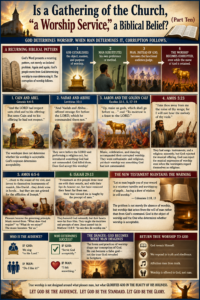 God’s Word presents a recurring pattern, not merely an isolated problem. Again and again, God’s people move from God determining worship to man determining it. The corruption of worship follows.
First, God establishes the object, manner, and purpose of worship. Second, man substitutes his own preference or method. Third, man, instead of God, becomes the functional audience/judge. Fourth, the worship becomes corrupted, even while the name of God is retained.
Genesis 4 is foundational. Cain and Abel both bring offerings to God. Cain apparently intends to worship God. But God does not accept both offerings (Genesis 4:4-5).
And the LORD had respect unto Abel and to his offering: But unto Cain and to his offering he had not respect.
The important principle is that the worshiper does not determine whether his worship is acceptable. Cain could not say: “But I sincerely offered this to God.” God’s response determined acceptability. That principle remains fundamental throughout scripture.
God Determines the Form of Worship
Nadab and Abihu
Leviticus 10:1 is even more explicit:
And Nadab and Abihu. . . . offered strange fire before the LORD, which he commanded them not.
The problem was not that they were worshiping a different god. They were before the LORD and were performing a religious act, but they introduced something “which he commanded them not.” And God killed them. This is one of the clearest demonstrations that “we are worshiping God” is not sufficient justification for what we do in worship. The question is: Does God accept this worship? That immediately destroys the modern idea that the sincerity of the worshiper or his subjective experience is sufficient authentication.
Aaron and the Golden Calf
Exodus 32:1 says: “Up, make us gods, which shall go before us. . . .” Aaron then makes the calf and declares (32:5): “To morrow is a feast to the LORD.” They did not simply say: “Let’s abandon Jehovah.” Instead, they incorporated the calf into their worship and attached the LORD’s name to it. The result was music, celebration, dancing, and religious excitement (32:17):
And when Joshua heard the noise of the people as they shouted, he said unto Moses, There is a noise of war in the camp.
Moses then sees “the calf, and the dancing” (32:19). Musical and expressive activity accompanied their corrupted worship. They were both enthusiastic and religious. Yet, their worship had become something God had not commanded, and their conception of God had been corrupted. The name was retained. The worship was corrupted.
Once man becomes the functional audience, man begins determining what God should be worshiped like. The golden calf becomes a paradigm: God as revealed by God → God as desired by man → worship constructed according to man’s conception → religious excitement → God rejects it. That is why no one can or should try to isolate musical style from theology, the biblical doctrine of God. Music does contribute to a representation of God.
Israel Repeatedly Turned Worship into What Pleased Themselves
Isaiah 1
Isaiah 1 is one of the great Old Testament passages on this. God says (1:11):
To what purpose is the multitude of your sacrifices unto me? saith the LORD. . . .
They had sacrifices, religious assemblies, offerings, and songs and religious observances. But God says (1:13):
Bring no more vain oblations; incense is an abomination unto me. . . . I cannot away with; it is iniquity, even the solemn meeting.
Their worship had become vain. The issue was not lack of religious activity. It was that their religious activity had become disconnected from obedience to God.
Amos 5-6
Amos 5 gives us the same pattern, specifically involving singing or music. God says (5:21), “I hate, I despise your feast days. . . ,” and then (5:23), “Take thou away from me the noise of thy songs; for I will not hear the melody of thy viols.” There it is. They had songs, instruments, and a religious assembly, but God rejected the musical offering. Why? Because their worship was corrupt.
God continues (5:24):
But let judgment run down as waters, and righteousness as a mighty stream.
This devastates the idea that “if the music produces a worshipful feeling, it must be acceptable.” God specifically rejects their music. It establishes another important principle. God can reject the musical expression of worship even when the worshipers regard themselves as religious.
Pleasure can become the governing principle. Amos describes those who (6:5) “chant to the sound of the viol, and invent to themselves instruments of musick, like David.” And they are described as those who (6:6) “drink wine in bowls, and anoint themselves with the chief ointments: but they are not grieved for the affliction of Joseph.” The striking phrase is “invent to themselves instruments of musick.” Their musical activity had become part of their self-indulgence. Music can move from “What does God require?” to “What do we enjoy?” The music becomes “for us.”
Isaiah 29:13
God says in Isaiah 29:13:
Forasmuch as this people draw near me with their mouth, and with their lips do honour me, but have removed their heart far from me. . . .
Then, “their fear toward me is taught by the precept of men.” Herein is the fundamental corruption. God is being worshiped outwardly, but man’s instruction has replaced God’s revelation. Jesus quotes this passage in Matthew 15:8–9:
This people draweth nigh unto me with their mouth, and honoureth me with their lips; but their heart is far from me.
Then: “But in vain they do worship me, teaching for doctrines the commandments of men.” Notice that Jesus doesn’t say: “They are not worshiping.” He says: “In vain they do worship me.” That is crucial. The problem is corrupted worship, not merely absence of worship.
The New Testament Therefore Continues the Same Warning
The Fundamental Problem of “Will Worship”
The church doesn’t escape the problem merely because it is now the New Covenant. Paul warns (Colossians 2:18):
Let no man beguile you of your reward in a voluntary humility and worshipping of angels. . . .
And he describes something that has “a shew of wisdom in will worship.” “Will worship” is an extremely important expression. It points toward worship arising from the will of man rather than from God’s command. So the NT maintains the same fundamental problem: What happens when man begins determining worship?
As the Object of Worship, God Determines the Worship
Jesus’ worship of God in the wilderness provides the opposite pattern. Satan offers Jesus a shortcut (Matthew 4:9):
All these things will I give thee, if thou wilt fall down and worship me.
Jesus responds (4:10):
Thou shalt worship the Lord thy God, and him only shalt thou serve.
The issue is not simply whether Jesus worships. The issue is whom and how. Christ refuses worship on Satan’s terms. That gives us the governing principle: The object of worship determines the manner of worship. If God is the object, God determines the worship.
A Profound Difference Between Biblical Joy and Manufactured Excitement
The Bible commands Psalm 100:2): “Serve the LORD with gladness.” It commands (Psalm 33:1, Philippians 4:4): “Rejoice in the LORD.” So biblical worship is not supposed to be emotionally dead. But Scripture never makes the intensity of emotion the proof of God’s presence. The proper order is: God → truth → apprehension → affection → worship. The corrupted order is: music/atmosphere → sensation → interpretation → “God was present.” That distinction is enormously important.
Warnings About “Another Jesus” Become Relevant
Paul says (2 Corinthians 11:4): “For if he that cometh preacheth another Jesus, whom we have not preached. . . .” This demonstrates that it is possible to retain Christian vocabulary while altering the object. The framing of the argument about musical style is important. The danger isn’t “a certain chord progression creates another Jesus.” That’s not something scripture teaches. The danger instead is that the forms and practices surrounding worship can contribute to a conception of God that is inconsistent with God’s revelation. The worshiper can then respond to his own conception of God, rather than God Himself.
Scripture Repeatedly Condemns Worship Designed Around What Pleases Man
There is a recurring biblical vocabulary:
“the imagination of their evil heart” (Jeremiah 7:24)
“walked after the imagination of their own heart”
“every man did that which was right in his own eyes” (Judges 21:25)
“will worship” (Colossians 2:23)
“commandments of men” (Matthew 15:9)
“strange fire. . . . which he commanded them not” (Leviticus 10:1)
These are different contexts, but they repeatedly expose the same fundamental problem: Man substitutes his own judgment for God’s revealed will.
So then, what happens when a congregation begins choosing the musical expression of worship according to the response of the congregation rather than the character and revealed will of God? The biblical answer is: Worship becomes man-centered. And once worship becomes man-centered, music naturally becomes increasingly functional: to attract, to excite, to create atmosphere, to generate emotion, to produce a response, to make people feel God’s presence, and to keep people coming. The music is no longer merely an offering to God. It becomes a means of manipulating the worshiper.
The Audience Question Is Right at the Center
The fundamental question is: Who gets to determine what worship is? If God does, His character governs worship. If man does, man’s preferences govern worship.
Then the next question is: Who is the audience? If God: “Singing is to the Lord.” If man, then man is asking, “Do I like it?”
And the next question is: Who determines whether it succeeded? If God: “Serve God acceptably.” If man, then man concludes, “I felt something.”
Those three questions are inseparable: first, authority; second, audience; and then, third, authentication. When all three move from God to man, the corruption of worship is virtually inevitable.
The Bible itself repeatedly presents man’s taste, imagination, pleasure, and religious innovation as precisely the things that can corrupt worship. The solution isn’t to replace contemporary taste with traditional taste. The solution is to return the authority, audience, and standard of worship to God Himself.
More to Come
“The solution isn’t to replace contemporary taste with traditional taste.”
Your analysis is spot on. The larger problem in the fundamental movement is exactly replacing contemporary taste with traditional taste, meanwhile all the underlying pragmatism and man centered problems with the contemporary worship remain. “Why do we sing hymns” is functionally, “because we’re building and catering to a traditional audience” and “because this is how you touch hearts.” It doesn’t seem often to be, “because we’re offering Scriptural worship to be accepted by God.”
It’s highly probable that the forms of worship taken by Cain, Nadab and Abihu, Korah, Micah’s private worship center, the Danites alternative worship center at Dan, Eli’s religious activities, Saul’s sacrifices, Jeroboam’s alternative worship centers at Dan and Bethel, and Uzziah’s incense offering all appeared outwardly traditional and conservative. They could probably frame their activities in their own minds and to their people as “the old fashion way,” or “well meaning.” Great series, thank you for writing.
Thanks! Appreciate it.