Part One Part Two Part Three Part Four Part Five Part Six Part Seven Part Eight Part Nine Part Ten Part Eleven
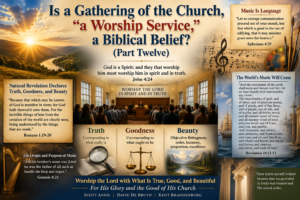 Thomas Jefferson’s phrase “these truths are self-evident” is not itself a doctrine of natural revelation or a theory of aesthetics. It does rest, however, upon a scriptural exegesis or worldview. Some truths are accessible to human beings through their rational and moral encounter with the created order, rather than depending upon a special revelation for their initial recognition. That connects very naturally with the biblical doctrine of general or natural revelation and, philosophically, with the transcendentals of truth, goodness, and beauty.
A real category of ordinary, shared human perception grounds itself in God’s creation. We don’t need scripture to tell us that a funeral communicates mourning, a naked body conveys nakedness, a sexually provocative pose manifests sexuality, a clenched fist shows anger, a gentle embrace speaks of tenderness, a wedding ceremony expresses union, a uniform can portray authority, chaotic visual arrangement displays disorder, and sexual ambiguity articulates gender confusion.
Though scripture gives the moral and theological interpretation of varied realities, human beings already encounter these realities themselves. God’s general revelation makes this possible. However, when Jefferson wrote, “these truths to be self-evident,” he was not saying, “we have feelings that these things are true,” nor “these are true because most people prefer them.” He was appealing to something outside the individual preference of the observer. Reality exists, and human beings possess a capacity to recognize truths about that reality. This relates to the fundamental epistemological assumption behind natural revelation.
Natural Revelation Begins with God’s Real Creation
The Apostle Paul writes (Romans 1:19-20):
Because that which may be known of God is manifest in them; for God hath shewed it unto them. For the invisible things of him from the creation of the world are clearly seen, being understood by the things that are made.
The movement according to this scripture is this:
God → creation → human perception → knowledge
God makes something. Man sees it. Man understands something from what he sees. The created thing is therefore not merely an object that produces subjective sensations. It is a significant reality from which something true can be known. The same principle applies across the board then to truth, goodness, and beauty. Premodern Christians spoke of these three as transcendentals. In its simplest form, the idea is that reality is not merely there. Reality is intelligible, ordered, and capable of being apprehended as:
- true — corresponding to what really is;
- good — corresponding to what ought to be; and
- beautiful — possessing an objective fittingness, order, proportion, harmony, or excellence that properly calls forth admiration.
These are not three unrelated things per se. They are different ways of considering reality. Something can be true because it corresponds to reality. It can be good because it corresponds to the proper order of reality. Something can be beautiful because its form manifests an appropriate order, unity, harmony, proportion, or excellence that accords with reality. And ultimately, in the Christian worldview, all three terminate in God, because God is the source and standard of reality.
Aesthetics Is Very Much More Than “I Like It”
If beauty means “I like this,” then beauty has no necessary relationship to truth or goodness. But if beauty is related to reality, then the question becomes: “Is this beautiful because it appropriately expresses or manifests something true and good about reality?” That provides the objective framework for evaluating art, including music.
For example, suppose two artistic forms depict marriage. One shows marriage as covenant, fidelity, self-giving, permanence, masculine and feminine complementarity, and sacrificial love. Another portrays it as sexual gratification, personal fulfillment, temporary emotional satisfaction, self-expression, and autonomy. The two forms aren’t merely different “styles.” They are communicating different conceptions of reality.
One can therefore ask which conception corresponds to what marriage actually is. That is a question of truth. Then, which one presents marriage according to the good order God established? That is a question of goodness. Finally, which form presents that truth and goodness with fittingness, proportion, harmony, dignity, and excellence? That is a question of beauty, that is, an aesthetic question.
Aesthetics Not Just Personal Taste
Aesthetics corresponds to ontology and morality rather than being isolated as personal taste. This again conforms to Genesis 3 back at the very beginning, which (3:7) says:
And the eyes of them both were opened, and they knew that they were naked.
The divinely inspired text does not at all indicate that Adam and Eve first needed a philosophical seminar on what nakedness was. They saw reality and knew what they saw. Likewise, human beings can see a naked body, a partially exposed body, a sexually provocative posture, masculine appearance, feminine appearance, deliberate blurring of those distinctions, tenderness, violence, disorder, peace, arrogance, and humility. They may subsequently approve or disapprove of what they see, and sin can corrupt that judgment.
Both Adam and Eve had already sinned when they perceived their nakedness. The reality that sin perverts judgment doesn’t eliminate the ability to perceive. Neither did they wholly lose his likeness to God when they ate of the tree. They forfeited their moral likeness to God, but with natural revelation from God, they could still perceive truth, goodness, and beauty. The deadness of depravity does not forego the power of God’s revelation. Their perception could still be reality.
“Beauty Is In the Eye Of the Beholder” Isn’t True
Scripture Joins Beauty with Truth and Goodness
If beauty were nothing more than subjective preference, there could be no meaningful relationship between beauty and truth or beauty and goodness. But Scripture repeatedly joins these categories. Philippians 4:8 says:
Finally, brethren, whatsoever things are true, whatsoever things are honest, whatsoever things are just, whatsoever things are pure, whatsoever things are lovely, whatsoever things are of good report; if there be any virtue, and if there be any praise, think on these things.
Notice that Paul does not say, “Think on whatever you personally find attractive.” He gives objective categories: truth, honesty, justice, purity, loveliness, good report, virtue, and praise. These categories belong together. “Lovely” is especially important. Paul does not treat aesthetic attractiveness as an autonomous realm detached from morality and truth. He says Christians should direct their minds toward things that are “true, . . . just, . . . pure, . . . . and lovely.” The beautiful is therefore not disconnected from the true and good. This gives us a distinctly Christian aesthetic.
Scriptural Permission to Evaluate Aesthetic Form
With the scriptural parameters, someone shouldn’t merely ask, “Is this pleasing?” Instead, he should also ask, “Is it true? Is it good? Is it pure? Is it lovely? And is it worthy of praise?” And those questions can be brought into the evaluation of artistic forms.
Suppose music communicates sensuality. The question is not: “Can I prove with a dictionary that this rhythm means sensuality?” That is asking the wrong question. The right question is: Does this musical form objectively participate in or communicate a sensual expressive character that human beings can recognize? Scripture in fact provides the means to evaluate that communication.
If music communicates something fitting to holiness, dignity, sobriety, joy, peace, reverence, majesty, or other qualities consistent with biblical truth, it can be evaluated accordingly. If it communicates qualities that contradict what the words are saying about God, then you have a problem of aesthetic correspondence. The music and the words are communicating simultaneously.
Beauty Is Not Abstract
God is not merely one beautiful thing among other beautiful things. He is the source of all goodness and beauty. Psalm 96:9 says: “O worship the LORD in the beauty of holiness.” Scripture does not say: “Worship the LORD in whatever beauty your culture happens to prefer.” Nor does it say: “Worship the LORD according to what produces the strongest emotional response.” It connects worship with “the beauty of holiness.” Holiness has an objective character. Therefore the beauty appropriate to worship must be related to that objective holiness.
If musical style is genuinely incapable of communicating anything, then perhaps it would be irrelevant. But if it communicates, then it cannot simply be removed from evaluation. Scripture commands “O worship the LORD in the beauty of holiness;” therefore the question is not whether music is capable of being evaluated as a moral proposition. The question is whether the whole form of worship is fitting to the God who is worshiped.
Natural Revelation and Objective Art
Natural revelation tells us that God has made a real world. That world has order, distinction, intelligibility, beauty, goodness, and moral structure. Human beings perceive that they can actually know things about that world, see distinctions, hear expressive qualities, and recognize order and disorder, beauty and ugliness, modesty and immodesty, and tenderness and violence. Scripture then gives God’s authoritative interpretation and moral judgment concerning that reality. Special revelation doesn’t make the natural world suddenly meaningful. Rather, it corrects, clarifies, completes, and authoritatively interprets what God has already made.
Art is possible because God created a real world, made man in His image, and gave man the ability to perceive and represent that world. Therefore, subject preference does not create artistic communication ex nihilo. True art draws upon realities that exist independently of the artist and the observer. Scripture then supplies the authoritative standard by which those realities and their artistic representations are judged.
Self-Evident Art
Jefferson’s statement in the Declaration illustrates a worldview that once took objective reality seriously. Its foundation is biblical: “the invisible things of him from the creation of the world are clearly seen” (Romans 1:20). His “these truths are self-evident” illustrates the broader intellectual assumption that truth is not manufactured by individual preference. Still, true, biblical Christianity goes much further. It also explains why there is truth at all — because there is a Creator.
And because there is a Creator, there is a created order. Because there is a created order, reality has intelligible structure. Then because man is made in the image of God, man can know that reality. And because man is fallen, his perception and judgment require correction. Finally, because God has given scripture, man also has an infallible standard by which to correct his faulty judgment.
Art belongs to the realm of general revelation because human beings take the raw materials of creation — light, color, sound, words, ideas — and form them into imaginative symbols. The perception of beauty in art corresponds to the perception of God’s beauty in creation. Art does not equal subjective preference. Instead, God creates reality. → Man perceives reality. → Man creates artistic representations of reality. → Other people perceive those representations → And then, those representations shape how people imagine reality.
Music As Art Shapes Imagination of God
That final step is extremely important. Art does not merely reflect imagination. It forms it. Art shapes imaginative perception. Aesthetic forms communicate not merely the what of biblical content but also how someone imagines that content. Therefore, worship forms should correspond to the aesthetic forms by which scripture communicates truth. Music and art are not passive. They teach people how to see. And this comes directly back to worship.
If the congregation repeatedly experiences God through artistic forms that communicate casualness, sensuality, theatricality, aggression, sentimentality, entertainment, self-expression, and emotional catharsis, then those forms will shape the congregation’s imagination of God. Eventually, the worshiper will think, “This is what experiencing God feels like.” But what he has learned is, in reality, an aesthetic conception of God formed by the artistic environment.
More Serious Than “Musical Preference”
The contemporary argument often goes — “You like traditional music; I like contemporary music — but that reduces the question to consumer preference. Instead, the significant question to ask is: What reality does each form communicate and cultivate? That is an entirely different question. Aesthetic form should correspond to reality and, particularly in Christian worship, to the truth and aesthetic forms of scripture. Leaders of worship and the worshipers in the church should evaluate whether its content agrees with scripture. Then they should judge whether its form remains consonant with that content and produces appropriate responses.
The biblical standard ultimately goes beyond what people perceive. Human perception is evidence of communication, but human perception is not the final standard of morality. The final standard remains God’s revelation. A person might perceive something correctly and judge it wrongly, perceive something incompletely, or have his perception distorted by sin.
God created the world with order and meaning. Man perceives that reality through God’s general revelation. He represents or interprets aspects of that reality through art. Others perceive the artistic communication and respond emotionally and imaginatively. Then, God’s Word judges whether that reality, representation, affection, or response is good, true, beautiful, holy, fitting, or corrupt. That is not saying: “I know this music is bad because I don’t like it.” Neither is it declaring: “Nobody can say this music is wrong because music is subjective.” Neither of these is biblical.
This Brings Us Back to the Audience
If man is the audience, then man judges the music. “Do I like it?” “Does it move me?” “Does it make me feel God’s presence?” “Does it attract people?” “Does it sound contemporary?” “Does it communicate to our culture?” But if God is the audience, then the questions become: “Does this honor God?” “Is it fitting to His character?” “Does it communicate truth appropriately?” “Does it cultivate ordinate affection?” “Does it offer God what He has commanded?” “Is it beautiful in the sense of being appropriate to the beauty of holiness?”
When the congregation sings and plays to God, the congregation benefits secondarily; consequently, the central question is not what people like but whether God accepts the music.
Music Has a Broader Cultural Use Than Worship
Genesis 4:17–22 give the first biblical reference to musical instruments and place their development in a context that is not itself described as worship. It shows that music has a broader God-given cultural use than worship, so it does not simply equate the existence of music with worship or assume that every musical expression is appropriate for worship. Music itself is not synonymous with worship. It existed before the Old Testament temple, before the Levitical priesthood, before the tabernacle, and outside God’s specifically prescribed worship.
That means that music can have a legitimate place in human culture without thereby being worship. This distinction is essential because the modern discussion often assumes something like: “Music is music, and therefore whatever music people use can simply be brought into worship.” But Genesis 4 gives us the opposite starting point. Music is a human cultural activity, and then God later gives His people particular instructions concerning music in His worship. The existence of music does not tell us what music God wants in His worship.
The Context of Jubal Is the Development of Human Culture
Within the Cainite Civilization
Genesis 4 presents several developments in the Cainite civilization. Jabal develops the culture associated with “tents” and “cattle.” Jubal formulates the use of “the harp and organ.” Tubalcain becomes “an instructor of every artificer in brass and iron.” Genesis is therefore describing the development of human civilization: pastoral, musical, and technological development.
These developments are not presented as three different forms of worship. They are advancements in human culture. Music itself is not sacred. A harp is not sacred merely because it is a harp. An instrument is not worship merely because somebody plays it. Music is not worship merely because somebody uses religious words with it. The biblical category of worship is narrower than the category of music.
Music: Cultural Development within Cain’s Genealogy
As Moses tells the true story of humanity, under God’s inspiration, he places this cultural development within the genealogy of Cain. The text does not say: “Music is evil because Jubal was a descendant of Cain.” That goes beyond scripture. Moses discloses that Cain departed from the presence of the LORD (Genesis 4:16): “And Cain went out from the presence of the LORD.” Cain then builds a city (4:17), and his descendants develop various aspects of human civilization. By the end of the genealogy, Lamech’s speech reveals a culture of increasing violence and vengeance (4:23):
I have slain a man to my wounding, and a young man to my hurt.
So Genesis 4 gives us an early picture of human civilization developing while humanity remains in rebellion against God. Music belongs to that cultural development. Again, that does not make music sinful. It does mean, however, that the existence, popularity, sophistication, or cultural usefulness of a musical form does not establish its fitness for the worship of God. That is a crucial distinction.
Someone might reason: “If God allowed music to develop through Jubal, then music itself is neutral, and therefore any musical style can be used in worship.” But that does not follow. Genesis 4 tells us where the development of musical instruments occurred. It does not tell us what musical forms God later approves for His worship. That comes later.
The Bible subsequently gives God’s people instructions concerning singing, instruments, priests, Levites, the tabernacle, the temple, and the worship of the congregation. Therefore, we should distinguish music as part of human culture from music as an appointed component of God’s worship. Those are related but not identical categories.
“Music Is Amoral” Is an Inadequate Argument
One can find a legitimate truth hidden inside the notion that “music is amoral.” If by that statement someone means “a musical instrument or musical sound, considered as a physical phenomenon, is not itself a moral agent,” that is obviously true. A harp does not sin. A trumpet does not sin. Neither does a piano. But if someone means, “therefore, every musical expression is equally suitable for every purpose, including the worship of God,” that conclusion does not follow. The Bible never reasons that way.
Someone can use a physical object for different purposes. And the use of something can be evaluated morally. Paul gives us a simple example in Romans 14:23: “for whatsoever is not of faith is sin.” The moral question is not merely what an object physically is. It is what God’s people do with it, why they do it, and whether that use fits God’s revealed will. The same principle applies to music.
Music Serves Different Purposes
Genesis 4: Again the Starting Point
Genesis 4:21 therefore gives us a helpful starting point for understanding the purpose and use of music. Music can be used for human cultural expression, entertainment, celebration, emotional expression, communication, military or ceremonial purposes, and, when God appoints it, for worship. The fact that something can be used for one purpose does not make it appropriate for every other purpose.
People can use a building for a theater and a church. They can use their voices for a joke and a prayer. They can use their words for entertainment and for scripture. Indeed, they can use instruments for cultural music and for worship. The context, purpose, manner, and object matter. This is exactly why the church must not reason: “People use this music in the world, but music is amoral, so we can use it in worship.” That skips the very question that needs answering: What is this musical form communicating, and is that communication fitting for the worship of God?
Scripture Reveals the Different Purposes
The development of music does not make all music worship. If music itself were automatically worship, then Jubal’s development of the harp and organ would already constitute an act of worship. Scripture does not say that. The distinction becomes very clear. Music is a means. Worship is an act directed toward God. Music can become part of worship when God’s people use it as an appointed means of offering praise to Him. But music itself is not inherently worship.
Modern Christianity has sometimes blurred these categories in both directions. On one side, some treat all music as worship. On the other side, some say that because music is not inherently worship, no musical form can be judged in relation to worship. Neither follows. The biblical position is more precise. Music is a cultural means capable of communicating meaning, and when brought into the worship of God, its use becomes subject to the character, purpose, and standards of that worship.
More to Come