Part One Part Two Part Three Part Four Part Five Part Six Part Seven Part Eight Part Nine Part Ten Part Eleven Part Twelve
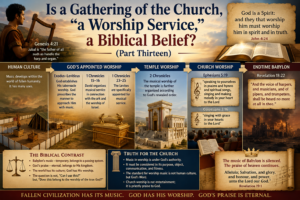 Distinguishing Jubal and Endtime Babylon from Temple and Church Worship
Scripture shows a progression in music. In Genesis 4:21, Jubal is “the father of all such as handle the harp and organ.” Music is part of developing human culture. Then in Exodus and Leviticus, God establishes His tabernacle worship. Now worship is not simply whatever human beings develop culturally. God prescribes the manner to approach Him with music. In 1 Chronicles 15–16, David organizes musical service in connection with the ark and the worship of Israel. Then in 1 Chronicles 23–25, the Levites are specifically appointed for musical service.
In 2 Chronicles, the musical worship of the temple is further organized according to God’s revealed order. And then in the New Testament (Ephesians 5:19 and Colossians 3:16:
speaking to yourselves in psalms and hymns and spiritual songs, singing and making melody in your heart to the Lord
singing with grace in your hearts to the Lord
So the biblical story moves from music as human cultural development to music specifically appointed and regulated as part of Old Testament worship to singing directed to the Lord in the church. Genesis 4 also connects with Revelation 18. At one end of Scripture, Jubal’s musical culture develops within the world of fallen humanity. At the other end, Revelation 18 describes Babylon’s music disappearing when God judges the world system (18:22):
And the voice of harpers, and musicians, and of pipers, and trumpeters, shall be heard no more at all in thee.”
There is a profound canonical picture: fallen civilization has its music, as then seen in Babylon; God has His worship; and Babylon’s music does not survive Babylon’s judgment. The music associated with the world’s system is temporary. The praise of God is eternal.
The World’s Music Is Not the Final Form of Music
Revelation 18:22 specifically identifies the disappearance of Babylon’s musicians and musical sounds. This is significant. The world’s system has its own culture, commerce, pleasures, arts, and its own music. And when God brings judgment upon that system, its music disappears with it. It does not say that every musical form ever used by unbelievers will cease to exist, nor does it say that all music itself disappears from creation. The immediate subject is the music associated with fallen Babylon, but the theological picture is nevertheless striking.
Babylon’s music belongs to Babylon. It does not have eternal standing. It disappears when Babylon disappears. And what follows immediately in Revelation is not a celebration of the world’s cultural production. The scene moves toward heaven, God’s judgment, and the praise of God. Revelation 19 begins with:
Alleluia; Salvation, and glory, and honour, and power, unto the Lord our God.
The contrast is profound. The music of Babylon is silenced. The praise of heaven continues.
Scripture portrays a world in which Babylon and the people of God are fundamentally different, two distinct poles apart. Babylon has its own culture. God’s people have theirs too, and especially their own worship. Babylon’s music belongs to a passing system. God’s praise belongs to the eternal kingdom. Therefore, the Christian cannot simply reason: “The world likes this musical expression, and I like it too, so there is no reason I cannot bring it into God’s worship.” That reverses the biblical direction. The question should be: Does this expression belong fittingly to the worship of the true God?
Revelation 18 Gives a Picture of God’s Final Victory Over the World System
The problem with worldliness is not merely that something originated somewhere outside the church. The deeper problem is that the world embodies a system of values opposed to God. John says (1 John 2:15): “Love not the world, neither the things that are in the world.” And Babylon in Revelation represents the organized system of human wealth, pleasure, power, luxury, deception, and rebellion against God. Consequently, the church should not ask only: “Can I use this?” It should ask: “What does this belong to?” And: “What does this communicate?” And: “Does it fit the worship of God?”
Genesis 4:21 prevents us from making the mistake of equating music itself with worship. Jubal’s development of the harp and organ occurs in the development of human culture, not in a recorded act of divine worship. Music therefore has uses beyond worship. But this does not establish that every musical expression is equally fitting for worship. Rather, it establishes that music is a human means that people might use for different purposes.
Conclusions from the Progression of Music through Scripture
When God appoints music as an element of His worship, it comes under the authority of that worship. The player, singer, or user considers it according to its purpose, object, communication, and fitness. The church does not receive its standard for worship music from Jubal, Cainite culture, Babylon, or audience preferences. It receives its standard from God. This shows that the question, “Is the music moral?” is not sufficient. Instead, “What is this music doing?” If it is being used to communicate something about God, then what is it communicating?
If the singer, player, or user is expressing affection toward God, is that affection rightly ordered? In manner, what the assembly uses in worship should fit the holiness, majesty, truth, goodness, and beauty of God. Music may be a legitimate part of common human culture and still be inappropriate as an expression of the church’s worship. Conversely, music fitting for worship may have legitimate uses outside worship. The category of music is broader than the category of worship.
The issue, then, is not whether music is “neutral” in some abstract sense. The issue is whether the particular use of music communicates appropriately. Jubal shows us that music exists as a cultural gift and human means; God’s subsequent revelation shows that when that means is brought into His worship, man no longer determines its use merely according to his own taste. Music is a broad human means; worship is a particular God-directed use of means; and once music is used in worship, its communication and fitness must be evaluated according to the object of worship—God Himself.
How Fallen Man Comes to Regard Reality
A central issue is how fallen man comes to regard reality and therefore how he judges what is true, good, and beautiful. The world, the flesh, and Satan do not have to destroy man’s capacity to perceive reality to corrupt him. They can corrupt what he loves, what he desires, what he celebrates, what he fears, and therefore what he calls true, good, and beautiful. That is particularly important for worship. A church can retain a biblical vocabulary while the world increasingly forms its imagination, affections, standards of success, and aesthetic judgments.
The fundamental biblical problem is not the changing of reality. God’s creation remains what God made it to be. Truth remains true. Good remains good. Beauty remains beautiful insofar as it corresponds to reality, goodness, order, and God’s character. The problem is that fallen man does not love or judge reality according to what it is. Paul describes this in Romans 1:25:
Who changed the truth of God into a lie, and worshipped and served the creature more than the Creator.
The truth remains God’s truth, but man changes it into a lie in his thinking. The world system doesn’t have to manufacture a different universe. It takes God’s universe and interprets it falsely. Satan’s great work is deception concerning reality. Jesus says of Satan (John 8:44):
When he speaketh a lie, he speaketh of his own: for he is a liar, and the father of it.
Satan’s fundamental weapon is therefore falsehood. That is already present in Genesis 3. God said: “thou shalt not eat of it”; Satan reframed reality: “Ye shall not surely die.” Then he reframed God’s character: “God doth know that in the day ye eat thereof, then your eyes shall be opened.” The temptation was not simply: “Do something forbidden.” It was: “Believe a different interpretation of reality.” That is enormously important for aesthetics and worship. The battle is ultimately over what things really are.
Lust Makes the False Interpretation Desirable
James 1:14–15 gives the internal mechanism:
But every man is tempted, when he is drawn away of his own lust, and enticed. Then when lust hath conceived, it bringeth forth sin.
Lust does more than produce an isolated sinful act. It pulls the affections away from reality as God defines it. This is why a person can know something intellectually and nevertheless love its opposite. He can know that something is sensual and nevertheless desire sensuality, recognize pride and admire it, see worldliness and call it sophistication, acknowledge entertainment and call it worship, and recognize emotional excitement and call it the moving of the Spirit. The problem is not lack of sensory perception. It is disordered love.
If truth is distorted, goodness will be distorted. If goodness is distorted, beauty will be distorted. Eventually a person can begin to regard what is morally corrupt as aesthetically beautiful. Isaiah 5:20 says:
Woe unto them that call evil good, and good evil; that put darkness for light, and light for darkness.
Notice the language of light and darkness. There is a reversal of categories. Something is actually darkness, but man calls it light. Something is actually evil, but man calls it good. The same thing can happen aesthetically. Something fitting to worldliness can be regarded as beautiful. Something that is fitting to holiness can be regarded as dull, lifeless, unattractive, or irrelevant. The problem is therefore deeper than musical taste. It is a corruption of judgment.
Explaining Ecstasy, Enthusiasm, and Passion
Christianity according to the New Testament is by no means emotionally sterile. The first church in Jerusalem in Acts 2:46-47 “did eat their meat with gladness and singleness of heart, praising God, and having favour with all the people.” In Acts 5:41, the apostles “departed from the presence of the council, rejoicing that they were counted worthy to suffer shame for his name.” Paul and Silas sang in the prison (Acts 16:25):
And at midnight Paul and Silas prayed, and sang praises unto God: and the prisoners heard them.
That is remarkable emotional exuberance. Paul’s own emotional life was extremely strong. He says (Romans 9:2): “For I have great heaviness and continual sorrow in my heart.” And yet he also says (2 Corinthians 6:10: “As sorrowful, yet alway rejoicing.”
The Psalms are filled with intense affection. The issue is not emotion versus no emotion. Instead, it is:
Is emotion being generated and governed by truth, or is experience being used to authenticate what is believed to be true?
That is a major distinction. The biblical order is: revelation → truth → faith → rightly ordered affection → appropriate response. The counterfeit tends toward: stimulus → sensation → excitement → interpretation → “God must be in this.” The second reverses the authority structure.
1 Corinthians 1–3 Addresses Exactly This Reversal
Paul begins by contrasting “the wisdom of the world” with “the wisdom of God.” 1 Corinthians 1:20 asks: “hath not God made foolish the wisdom of this world?” And then Paul says (1 Corinthians 1:22-23):
For the Jews require a sign, and the Greeks seek after wisdom: But we preach Christ crucified.
There are two different approaches here. One wants experience/signs. The other wants intellectual sophistication. But Paul refuses to allow either worldly criterion to become the standard. God’s revelation governs.
Paul specifically rejects worldly rhetorical power. This is especially relevant to modern so-called worship. Paul says (1 Corinthians 2:1):
And I, brethren, when I came to you, came not with excellency of speech or of wisdom, declaring unto you the testimony of God.
And (2:4):
And my speech and my preaching was not with enticing words of man’s wisdom, but in demonstration of the Spirit and of power.
Then comes the reason (2:5):
That your faith should not stand in the wisdom of men, but in the power of God.
That is directly relevant to the pragmatic production of religious experience. Paul does not say: “If you can create an impressive experience, people will believe.” He deliberately rejects reliance upon human impressiveness. The Corinthians were in danger of evaluating spiritual reality according to worldly criteria. Paul redirects them to God’s revelation.
Identifying the Problem
Paul identifies the problem as carnality. By 1 Corinthians 3, Paul says:
I could not speak unto you as unto spiritual, but as unto carnal.
Why? “For whereas there is among you envying, and strife, and divisions.” Then, “For ye are yet carnal.” The church can possess Christian terminology, teachers, ordinances, and gatherings, and yet its judgments and affections can be carnal. Therefore, merely calling something “Christian worship” does not settle whether its manner reflects spiritual wisdom.
2 Peter gives the other side of the problem: false teachers. It is almost a textbook description of what happens when experience, desire, and worldly appetite displace revealed truth. Peter begins by emphasizing something entirely different (1:12):
Wherefore I will not be negligent to put you always in remembrance of these things, though ye know them.
He is deliberately grounding believers in remembered revelation. Then: “we have not followed cunningly devised fables.” And he points them to what they saw and heard, but crucially, he does not leave Christian certainty resting upon subjective experience. He says (1:19): “We have also a more sure word of prophecy.” And then (1:20): “knowing this first, that no prophecy of the scripture is of any private interpretation.” This is critical.
Peter’s answer to religious deception is not: “Find a more powerful experience.” It is: “Come back to the sure Word.”
2 Peter 2 Describes What Happens When Lust Takes Over
Peter introduces the false teachers (2:1):
But there were false prophets also among the people, even as there shall be false teachers among you.
What characterizes them? “And many shall follow their pernicious ways” (2:2). And then (2:3): “And through covetousness shall they with feigned words make merchandise of you.” This is extraordinarily relevant to religious pragmatism. People become merchandise.
Religious activity becomes something that can be marketed, packaged, sold, and optimized. And Peter connects the false teachers’ ministry with sensual desire (2:14): “having eyes full of adultery, and that cannot cease from sin; beguiling unstable souls.” And: “beguiling unstable souls.” The word beguiling is important. It involves seduction and deception. Peter connects false teaching with sensuality. 2 Peter 2:18 says:
For when they speak great swelling words of vanity, they allure through the lusts of the flesh, through much wantonness.
This is almost exactly the mechanism I’ve been describing through this series. There is swelling rhetoric, sensual appeal, lust, and unstable people, which equal religious deception. The result is not merely an incorrect doctrine on paper. It is a corrupted way of life. Peter says (2:19):
While they promise them liberty, they themselves are the servants of corruption.
They promise freedom while actually enslaving people to corruption.
Religious Experience Becomes Self-Authenticating
Suppose a church develops an environment that is capable of producing emotional intensity, bodily excitement, musical ecstasy, collective enthusiasm, cathartic release, and emotional attachment to the worship leader. People then say, “God was really here today.” But what establishes that conclusion? Not necessarily Scripture. The experience itself becomes the evidence. That is the critical error. The question changes from “Was this worship according to God’s revelation?” to “Did this make me feel like I encountered God?” Once that happens, experience becomes its own authentication.
Pragmatism then gives this process an institutional engine. Pragmatism asks: What works? But “works” can mean more people attend, stay longer, give more, report stronger experiences, feel connected, become enthusiastic, the church grows in number, visitors return, and people respond emotionally. Those results can then be interpreted as divine approval.
But Scripture never establishes that numerical success equals God’s approval. Israel could have enormous numbers and still be apostate. The prophets repeatedly confronted popular religion. Jesus says, “For many be called, but few chosen” (Matthew 22:14). And He says, “Enter ye in at the strait gate” (Matthew 7:14). The biblical question is not “Is it successful? but “Is it faithful?”
More to Come