Part One Part Two Part Three Part Four Part Five Part Six Part Seven Part Eight An Aside (Between Parts Eight and Nine) Part Nine
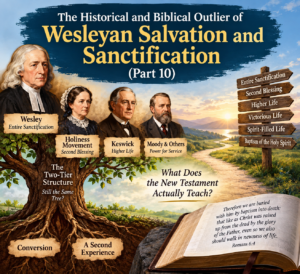 Each branch from Wesleyanism took certain fundamental unbiblical characteristics from its trunk, while also adding unique innovations. The Holiness Movement (part 9) followed Wesley’s two-tiered salvation scheme — initial and entire sanctification — but added distinct human means of accomplishment, such as public meetings, altar calls, and testimonials. Moreover, Phoebe Palmer helped make the second blessing into a definite, identifiable, reproducible, and transferable experience.
Subsequently, the Keswick or “Higher Life” Movement arose as the next branch, turning the second tier of Wesley into a crisis-oriented, post-conversion “higher” Christian experience. Initially, the Movement designed its early conventions to promote practical holiness. Adherents met at Oxford in 1874, and the following year at Keswick, from which it took its name. Keswick modified Wesleyanism. Traditional Wesleyans taught “eradication” — the idea of complete removal of original sin in this lifetime.
The Keswick teachers popularized the idea that a Christian retains two literal, competing entities: the “old sin nature” and the “new nature”. They taught that the sin nature remains entirely active, except for complete surrender of a believer (“Let go and let God”). This would bring a continuous counteraction of the sin nature by the power of the Holy Spirit. Keswick advocates called this “the victorious Christian life.” Instead of Wesley’s entire sanctification, the vocabulary became higher life, deeper life, victorious life, abiding life, full surrender, and Spirit-filled life. The two-tier question remained.
What Is the Higher Life?
The name itself reveals something. There is ordinary Christian life. Then there is the higher life. There is the Christian who has been converted. Then there is the Christian who has entered into the fullness of the Christian life. There is the believer who has Christ. Then there is the believer who has learned the secret of victory. There is the Christian who has been saved. Then there is the Christian who has discovered the deeper life.
The terminology is different from Wesley’s, but the structure is remarkably similar. That is why I have called this a branch rather than a new tree. The doctrine, vocabulary, and explanation of sin have changed, but the Christian life is still divided into levels.
Someone might say: “Keswick is not Wesleyan because Keswick rejected Christian perfection.” But what did Keswick retain from the Wesleyan system? It retained the expectation of a subsequent crisis, a distinction between an ordinary Christian life and a fuller Christian life, consecration or surrender as the necessary response, and that a believer could enter a new experience of divine power. The Keswick Movement increasingly connected this higher experience with the Holy Spirit and power for Christian service. This preserved the two-tier architecture even after rejection of the doctrine of eradication.
Difference With Little Difference
Wesleyan doctrine said, in essence, the second work cleanses inbred sin from the heart. Keswick generally taught that the sin nature remains, but the believer can live victoriously through dependence upon Christ and the Holy Spirit. That difference is significant, but both systems still speak of a crisis of consecration, a subsequent experience, entrance into a higher condition of Christian living, and a distinction between the ordinary Christian experience and a victorious Christian one.
Even though the vocabulary changed, the second tier didn’t disappear. For Wesley, it was entire sanctification; for Holiness, it was a second blessing; and for Keswick, it was higher life. A person may deny the word Wesleyan while retaining a Wesleyan structure, rejecting Christian perfection while retaining the two-tier Christian. He may reject eradication or entire sanctification, while retaining the crisis experience or higher life.
Keswick acknowledged conversion, yet without full surrender, something still held back. He has Christ, but he has not given Christ everything. In the Keswick architecture, God might save a person, but he won’t win the victory until he fully surrenders. He has Christ, but Christ doesn’t yet have Him. Is this the teaching of the New Testament (NT), though? The NT does not divide Christians into two categories: surrendered and not surrendered. “Present your bodies a living sacrifice” (Rom 12:1) and “yield yourselves unto God” teach Christians how to live their Christian lives.
No Second Tier in the New Testament
Paul does not say: “You were saved when you believed, but now you need another transaction so that you can finally become the kind of Christian God intended.” Instead, he tells those in Christ how to walk according to the new life they already received. He says (Romans 6:4):
Therefore we are buried with him by baptism into death: that like as Christ was raised up from the dead by the glory of the Father, even so we also should walk in newness of life.
The Christian does not need a higher life experience to begin walking in newness of life. He has already received new life. Now he needs to live consistently with it. That is sanctification. Paul says (Romans 6:11):
Likewise reckon ye also yourselves to be dead indeed unto sin, but alive unto God through Jesus Christ our Lord.
The word “reckon” becomes very important in Keswick teaching. However, Paul is not saying: “You have received salvation, but you need a second spiritual experience before Romans 6 becomes true of you.” No, the believer is to reckon what God has already accomplished to be true and live accordingly. What God already did produces what the believer does. The believer does not create a new spiritual status by his consecration. He responds to the status God has already given him in Christ.
“Reckon” is not some mystical switch. A believer might read Romans 6, consciously reckon himself dead to sin, and still be tempted. If he still sins, that doesn’t mean Romans 6 failed. It is not a mechanical formula: reckon → receive → victory. It is union with Christ producing obedience through the Spirit. God establishes a believer’s position in Christ, and then his progress in holiness occurs over time. Those are not two kinds of salvation. They are two aspects of one salvation.
The Problem of “Let Go and Let God”
“Let go and let God” expresses a summary of Keswick higher-life tradition. It speaks of sanctification as a kind of passive transaction, as if it calls Christians to become spiritually inert. The NT commands action.
“Mortify therefore your members which are upon the earth.”
“Put off all these.”
“Put on therefore, as the elect of God, holy and beloved, bowels of mercies.”
“Walk in the Spirit.”
“Be ye doers of the word.”
“Follow peace with all men, and holiness.”
The Christian does things. He obeys, fights sin, puts off, puts on, walks, follows, runs, labors, watches, prays, and endures. The Christian life is not passive. Dependence upon God does not eliminate obedience; it produces obedience.
The Higher Life and Abiding in Christ
Another important Keswick emphasis is “abiding in Christ.” Jesus does say (John 15:4), “Abide in me, and I in you.” But He isn’t creating two categories of believers: those who abide and those who don’t. Jesus is addressing His disciples. It isn’t whether some Christians have entered the “abiding life” and others have not. Every true believer abides. “Abide” translates a simple Greek word (meno) that means “remain.” That’s how you know they’re truly saved. They won’t exit the Christian faith.
The NT repeatedly emphasizes continuing, remaining, walking, obeying, believing, and persevering. The problem arises when ordinary Christian obedience is transformed into a special spiritual experience available only to those who have discovered the secret.
Higher-life teaching frequently presents the victorious life as something Christians have failed to discover. Proponents call it “a secret.” They believe the gospel, have salvation, the Bible, and attend church, but they have not learned the secret. Then someone tells them: There is a deeper life. In other words, there are two classes of genuine Christians. Keswick or Higher Life teachers give the impression that true believers missed something at their moment of conversion. Yet, it’s only a secret because it isn’t in the NT.
Carnal Christian Language
When Paul writes to the Corinthians (1 Corinthians 3:3-4) — “For ye are yet carnal” — he is not establishing a category of carnal Christian. Higher life teachers have gotten a lot of mileage off of this one statement by Paul. The flow of 1 Corinthians 2-3 by Paul dispels the category of carnal Christian, but Paul also provides a clue, as seen in the original language of the text.
1 Corinthians 3:1 — Sarkinos (“Made of flesh”)
1 Corinthians 3:3 — Sarkikos (“Controlled by flesh”)
The Ultimate Purpose of the Phrase
You are so messed up and acting so much like the world that I am forced to address you as if you were still completely unsaved, earthly people — even though I know you are actually infants in Christ.
There is no question that these Corinthians were immature. Their church had serious problems. Yet Paul does not tell them that they need a second salvation experience. He calls them to repentance, obedience, unity, love, and growth. Paul does not tell them: “You need to enter the higher Christian life.” He tells them to live like Christians.
Carnality Does Not Establish a Second Tier
There are genuinely immature Christians and mature ones. Some true believers walk in much greater consistent obedience than others. These differences do not establish a second kind of salvation. A baby is not a different species from a mature man. The immature Christian is not a different kind of Christian from the mature Christian. He is an immature Christian. The biblical goal is growth (2 Peter 3:18):
But grow in grace, and in the knowledge of our Lord and Saviour Jesus Christ.
Growth assumes life already exists. You do not grow into life. You grow because you have life. That is a critical biblical distinction.
The Higher Life Becomes a Portable Theology
The Keswick movement made the two-tier structure even more portable. While Wesleyanism smacked of Methodist holiness and Christian perfection, Keswick wouldn’t didn’t require it. The Keswick Convention detached the theology from its original denominational home, making it increasingly available to American evangelicalism.
D. L. Moody became one of the most influential American evangelists of the nineteenth century. Moody’s own theology was not identical to Wesley’s on perfectionism, but through the subtle changes of the Keswick Movement, he retained and promoted the same two-tiered structure. Moody embraced a second experience for those lacking spiritual power. With the second work connected to power, the evidence for receiving it naturally shifted toward results.
Did you become more effective and win souls? How did people respond? So, did the Spirit visibly empower your work? That moves toward the next branch from the root of Wesleyanism: the baptism of the Holy Spirit. The terminology is biblical, but the question is the theological system into which it is placed. If the baptism of the Spirit is a post-conversion experience that gives Christians an additional enduement of power for service, then it functions as the second tier.
Some historical accounts of Keswick explicitly describe the movement as teaching a subsequent appropriation of God’s power for holy living and Christian service and identifying this enduement with the baptism of the Holy Spirit.
More to Come