Part One Part Two Part Three Part Four Part Five Part Six Part Seven Part Eight An Aside (Between Parts Eight and Nine) Part Nine Part Ten
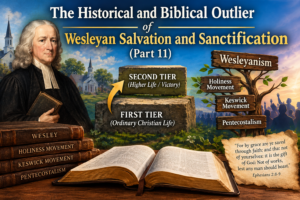 John Wesley changed the doctrine of salvation. It affected everything. It is important to know this. From the trunk of Wesleyanism came various branches that brought various modifications and editions of Wesley’s teaching, reinventing the gospel. Contrary to scripture, it turned salvation into a two-tiered process, as revealed in the branches of the Holiness Movement and Keswick Movement of the 19th century, both of which led to revivalism and Pentecostalism among other corruptions.
The “Higher Life” Lowers the First Tier
Scripture does not present two tiers of salvation. Still, with the two tiers Wesley introduced, the later “Higher Life” system of the Keswick Movement did not merely elevate the second tier. It lowered the first, essentially making it an unscriptural version of salvation. If there is an ordinary Christian life and then a higher Christian life, what does that make the ordinary Christian life? One Christian has Christ, but another has a fuller experience of Christ; one salvation, the other victory; one converted, the other surrendered; one having the Spirit, the other having the fullness of the Spirit; and one a Christian, the other the “higher life.”
The first tier remains technically Christian. Yet it becomes Christianity with something missing. The first tier apparently doesn’t provide everything necessary. That is not the New Testament (NT) presentation. The NT distinguishes between obedience and disobedience, faithfulness and unfaithfulness, and spiritual growth and spiritual stagnation. It does not divide genuine Christians into different permanent spiritual classes, dependent on a later second experience. The NT does not instruct adherents of a first tier to seek a higher Christian experience.
The believer does not receive a defective Christianity at conversion and then receive the complete form of Christianity later. When a person is born again, he receives life. He does not receive a preliminary form of life that later becomes real life or a partial version of eternal life until he reaches a subsequent crisis. A Christian who has already been raised with Christ “should walk in newness of life” (Romans 6:4). So, God gives new life and then the Christian walks in that new life. He does not first receive new life and then, through a second experience, receive the ability to begin possessing the kind of Christian life God intended.
The First Tier Becomes a Problem
“Higher Life” terminology changes the way professing Christians think about conversion. When a person hears about a “higher life,” he naturally understands his present condition as something lower. That creates a problem. What exactly is the status of the Christian who has never entered the higher life? Is he saved? Yes. Is he complete in Christ? Colossians 2:10 says:
And ye are complete in him, which is the head of all principality and power.
Does he possess the Holy Spirit? Yes. Romans 8:9 says:
Now if any man have not the Spirit of Christ, he is none of his.
Does he possess everything necessary for godliness? Peter says that God has given believers “all things that pertain unto life and godliness” (2 Peter 1:3). Then what exactly is missing? What is missing is not another category of salvation. It is growth, obedience, maturity, wisdom, and conformity to Christ. Those things are real needs, but they are not evidence that conversion supplied only the lower tier of Christianity.
A believer does not need another Christianity. He needs to live the Christianity he has. The answer to spiritual immaturity is not a second tier. It is growth in grace. If the Christian already has Christ, but the “higher” Christian has something more, what is that something more? The next branch would answer those questions with a new doctrine. It was called the baptism of the Holy Spirit.
Pentecostalism
Pentecostalism did not simply appear without historical connection to the preceding movements. It arose out of the soil already prepared by the Holiness and Higher Life movements. Charles Fox Parham, a former Methodist associated with the Holiness world, became an important early figure. At his Bible school in Topeka, Kansas, in 1901, he associated the phenomena of “speaking in tongues” with what he called the baptism with the Holy Spirit. He connected tongues to this experience as evidence.
Wesley’s second work centered upon holiness. The Holiness movement made that holiness into a definite second blessing. Keswick modified the doctrine by rejecting eradication while emphasizing victory through surrender and dependence. With Pentecostalism, the emphasis became empowerment. The Pentecostal interpretation centered heavily upon Acts 2. On the Day of Pentecost, the Holy Spirit came upon the disciples. They spoke with other tongues. Peter preached, and three thousand were saved afterwards. Pentecostalism argued that Pentecost was a pattern for Christian experience.
The Pentecostals, founders of the Charismatic Movement, treated “baptism of the Holy Spirit” as a subsequent experience available to believers. Speaking in tongues became the initial evidence of the “baptism,” a post-salvation experience, accompanied by signs and wonders. The Topeka events of 1901 and the Azusa Street revival beginning in 1906 were foundational developments for this viewpoint.
What Happened at Azusa Street?
William J. Seymour carried Parham’s Pentecostal teaching from Houston to Los Angeles in 1906. Seymour preached the Pentecostal message, and meetings began in homes before moving to a building on Azusa Street. The Azusa Street Mission became a major center from which Pentecostalism spread throughout the United States and internationally. It spread rapidly. Visitors came, received the Pentecostal experience, went elsewhere, preached it, and new Pentecostal centers developed. The movement became international.
Wesleyanism supplied the original two-tier architecture. The Holiness movement made the second blessing reproducible. Keswick detached the second tier from Wesleyan eradication and made it useful across denominational boundaries. Pentecostalism now made the second experience even more portable by identifying it with Spirit baptism. The movement no longer needed to be Wesleyan to have a second experience. It could retain the structure while changing the experience. Tongues became the evidence.
If a Christian receives a second experience, how does he know that he has received it? Wesleyanism had its testimony to entire sanctification. It created a new spiritual measuring system.
Have you spoken in tongues? Been baptized in the Holy Spirit? Received the power? Experienced Pentecost?
The search for the higher Christian life became the search for a particular experience. The Holy Spirit works. He regenerates, indwells, leads, produces fruit, gives gifts, and helps. The issue is not whether the Holy Spirit works, but whether scripture establishes a post-conversion spiritual tier that every Christian must seek to become what a Christian ought to. The Spirit is not an optional upgrade to Christianity. It is not that someone first becomes a Christian and then later a Spirit-possessing one.
The Sign Becoming the Center
The Corinthians possessed spiritual gifts. They spoke in tongues. They experienced manifestations that could be identified as spiritual gifts. Yet Paul considered them seriously immature. Their possession of extraordinary gifts did not prove extraordinary spirituality. Instead, their abuse of spiritual gifts was a reason why Paul had to correct them. An extraordinary experience cannot be a measure of Christian maturity. Once an experience becomes the proof of entering a higher Christian life, the experience itself can become the center.
The Christian no longer asks simply what scripture says. He asks what happened to him, what he felt, what manifestation occurred, and whether he received what others say they did. The question becomes: What is the final authority — the Word of God or an experience? Pentecostalism formally retained the Bible, but in practice, an experience can become the interpretive lens for scripture. Peter gives the opposite (2 Peter 1:19): “We have also a more sure word of prophecy.” The Christian does not need an experience more certain than Scripture. He needs to believe and obey what God has already revealed.
Pentecostalism created denominations and churches around the second experience, but the doctrine did not remain confined to Pentecostal denominations. It began moving into churches that did not identify themselves as Pentecostal. Instead of saying, “We are Pentecostal because we speak in tongues,” people increasingly began saying: “We are Baptists, Methodists, Presbyterians, Episcopalians, Catholics, or independent evangelicals who have experienced the Holy Spirit.” This would eventually become known as the Charismatic movement.
From Pentecostalism to the Charismatic Movement to Beyond
The Charismatic movement emerged in the twentieth century as Pentecostal-type spiritual gifts and experiences spread into many other denominations, conventions, associations, and churches. They adopted the Pentecostal second-tier structure without the entire Pentecostal denominational system. The fundamental question remained: Is what a Christian receives at conversion sufficient to constitute the whole Christian life God has revealed, or must the Christian enter another experience to become a fuller Christian?
The next question is even more revealing. What happens when the second-tier structure becomes detached from holiness altogether? Another development would arise in evangelicalism. It wouldn’t necessarily speak of entire sanctification, Spirit baptism, or tongues. It would, however, distinguish between carnal Christians and spiritual Christians. A person could be saved and remain carnal. Another might be saved and become spiritual. This would provide another way to explain why some genuine Christians seem to live so differently from others.
Now instead of asking, “Have you been entirely sanctified?” “Have you entered the Higher Life?” Or, “Have you been baptized in the Holy Spirit?” It would become: “Are you a carnal Christian or a spiritual Christian?” That took the two-tier structure directly into twentieth-century evangelicalism. With that, the consequences become even more significant. Because once Christianity can be divided into a lower and higher class of genuine believers, the doctrine of salvation itself encounters another question: What does it mean to be saved if salvation does not necessarily produce the kind of life scripture requires? That is where the next branch leads.
More to Come