Part One Part Two Part Three Part Four Part Five Part Six Part Seven Part Eight An Aside (Between Parts Eight and Nine)
 Wesleyanism, which began with John Wesley’s theology, supplied the historical architecture for a two-tier conception of salvation. This architecture subsequently changed names, crossed denominational boundaries, and then entered revivalism. The movement arising from Wesley’s novel soteriology transformed evangelicalism and fundamentalism. It eventually affected how many, maybe even a majority, of professing Christians understand conversion or the gospel itself, sanctification, Spirit-filling, assurance, and ministry effectiveness.
It’s been a while since I’ve written on this series, so here are some bullet points for review. The eight parts build a deliberate historical-theological progression:
-
- Wesleyan historical origins — Anglicanism, Wesley’s environment, and the strange combination of influences behind his theology.
- The biblical alternative to entire sanctification — the sufficiency of regeneration, positional sanctification, progressive sanctification, the Spirit’s indwelling, and sanctification through the Word.
- The internal incoherence of Wesley’s system — especially baptismal regeneration, apostasy, and the second blessing.
- One gospel, one birth, one standing, one Savior — moving from historical diagnosis toward the biblical alternative.
- The American transmission of Wesleyanism — Cane Ridge, revivalism, ecstatic experience, and the development of the Holiness tradition.
- The redefinition of sin and the transition into evangelicalism/fundamentalism — Wesley → Finney → Moody → Torrey → Chafer, with the two-tier structure increasingly stripped of its original Wesleyan terminology.
- The downstream gospel problem — later manifestations are not identical to Wesley, but they retain the underlying two-tier structure and its tendency toward a corrupted gospel.
- The trunk and branches — the crucial historical synthesis: a second, definite, experiential work beyond conversion, received through surrender/consecration, known through experience and results, and then expressed in different vocabularies.
Part 8 ended with this statement:
Before I start dealing with individual branches, I believe it would be easier to understand all this by looking at a chart or table that illustrates what happened.
That is where I want to go now: to look at the branches off of Wesley one at a time. One is the nineteenth-century American Holiness movement, especially through Phoebe Palmer. Everything taught by every person in the Holiness movement was not identical. Each person influenced by Wesley did not believe exactly what Wesley believed. However, the American Holiness movement took Wesley’s two-stage conception of Christian salvation and sanctification and made the second stage into a more definite, immediate, reproducible, and transferable experience.
Wesley’s Two Stages Become an American Method
John Wesley distinguished, albeit unscripturally, between what he called initial sanctification and entire sanctification. According to his system, initial sanctification accompanied conversion. Entire sanctification was an apparent subsequent work of grace that delivered the believer from inward sin and brought into perfect love. The American Holiness movement retained this basic distinction. More than anything, it also answered the question: How can I get the second blessing?
Bifurcating salvation into an initial experience and a subsequent one induces people from the first to the second. This theology then requires an accompanying method: seeking and obtaining the second blessing, a way to know it happened, a way to tell other people it happened, and a way for the movement to reproduce this experience in other people. This is where Phoebe Palmer becomes especially important.
Phoebe Palmer
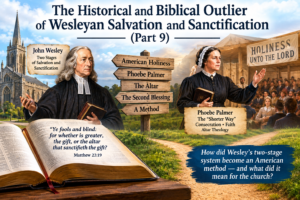
Phoebe Palmer (1807–1874) was a Methodist laywoman with enormous influence on nineteenth-century American Holiness. Beginning in the 1830s, she and her sister Sarah Lankford met with the Tuesday Meeting for the Promotion of Holiness in New York City. Those meetings promoted entire sanctification among Methodists and then professing Christians of other denominations. Palmer distinguished herself by originating a particular method for obtaining and knowing the experience of entire sanctification, what she called the “shorter way.”
Palmer’s “shorter way” emphasized consecration, faith, and an immediate claim to the blessing of entire sanctification. She developed what became known as “altar theology,” centered on the idea that the believer places himself upon the altar and then receives sanctification by faith. The altar became a method for experiencing a second blessing, an instrument to manufacture Wesley’s entire sanctification.
Palmer took the imagery of “altar theology” from Matthew 23:19:
Ye fools and blind: for whether is greater, the gift, or the altar that sanctifieth the gift?
In this context of Christ’s condemnation of the scribes and Pharisees, He was not explaining a method by which Christians receive entire sanctification. Instead, He was exposing the blindness and hypocrisy of religious leaders who had developed a false system concerning oaths and the temple. Palmer hijacked the language of Matthew 23:19 and made it central to her theology of entire sanctification. With the altar sanctifying the gift, a believer can consecrate himself too on an altar by placing himself upon it. She treated this as a promise of Jesus which, when exercised by faith and claimed as a blessing, would guarantee an instantaneous second work.
Wesley had supplied the two-tier structure. Palmer supplied the mechanism in the form of a formula: consecrate yourself, put all on the altar, believe, claim the promise, and testify to the blessing. This made the extra-scriptural doctrine of entire sanctification functional or operational.
Turning Matthew 23:19 Into a Mechanism for Entire Sanctification
Not What Jesus Was Saying
Matthew 23:19 doesn’t teach how to obtain a second work of grace, which Wesley called “entire sanctification.” The passage concerns the scribes and Pharisees and their corrupted treatment of the temple, the altar, the gift, and the oath. Jesus is not explaining a procedure for sanctification. Using exact verbiage from an English translation does not equal biblical exegesis or right division of the Word of Truth (cf. 2 Timothy 2:15). Neither does borrowing its exact words establish biblical doctrine, especially important when it concerns the nature of salvation.
The New Testament does not present the Christian as initially saved but still waiting for a later sanctification transaction that will finally make him a genuinely sanctified Christian. Paul could write to the Corinthians (1 Corinthians 1:2):
Unto the church of God which is at Corinth, to them that are sanctified in Christ Jesus, called to be saints.
“Sanctified in Christ Jesus”
1 Corinthians chronicles a people “sanctified in Christ Jesus,” who still needed enormous growth and correction for divisions, immorality, doctrinal confusion, abuse of the Lord’s Table, and problems with spiritual gifts. They needed correction, but the Apostle Paul did not therefore divide them into two classes:
Christians who had only received initial sanctification, and
Christians who had received entire sanctification.
No. Sanctified in Christ, they were still growing in holiness. That is the biblical pattern. The New Testament can say both (1 Corinthians 1:30, 2 Peter 3:18):
But of him are ye in Christ Jesus, who of God is made unto us wisdom, and righteousness, and sanctification, and redemption.
And
But grow in grace, and in the knowledge of our Lord and Saviour Jesus Christ.
There is no contradiction. Sanctification is something God gives to the believer in Christ, and sanctification is also something in which the believer progressively grows. The problem comes when a person or movement converts that biblical progression unscripturally into another salvation transaction.
Palmer’s “Shorter Way”
Palmer’s innovation brought concrete terms to the unbiblical teaching of entire sanctification. Her “shorter way” promoted a crisis experience, followed by a faith with no sensible requirement of evidence for such as the basis for claiming the blessing. She taught a public testimony as the means to maintain and confirm the experience.
With the Palmer “shorter-way, first a person is converted; he learns conversion won’t bring a full Christian life, so now he must seek entire sanctification. He consecrates himself, believes, claims the blessing, and then, as a kind of self-fulfilling prophecy, he testifies that he received it. The Christian requires two major salvation experiences. The first says, “I became a Christian,” and the second says, “I became entirely sanctified.” That is precisely the two-tier structure beginning with Wesley.
Assurance of the Blessing
When someone received the second blessing through the crisis experience, how did he know that he received it? Wesley and Palmer emphasized the “witness of the Spirit,” borrowed from scriptural verbiage. The American Holiness movement, emerging from Wesley and then Palmer, developed a culture that could produce and reinforce an experience. Her meeting became very important. The Tuesday Meeting was not a Bible study in the modern sense, but a place to come and seek holiness.
At Palmer’s meeting, people testified, sought the blessing, heard testimonies from those who had received it, which instructed them how to obtain the blessing, and encouraged them to consecrate themselves. The meeting facilitated the transmission of the second experience. Since the doctrine said, “You need a second experience,” they designed meetings to receive that experience. It could come in a moment based upon this altar standard falsely derived from Matthew 23:19.
The altar call proceeded from the public meeting. At an 1844 camp meeting in Belleville, New Jersey, at Palmer’s urging, its Methodist leaders gave an altar call to seekers of present holiness. That development is enormously important for the history of American evangelicalism. The altar was becoming a place where a person could move from one spiritual condition to another. The altar became a mechanism for a second Christian experience.
From Entire Sanctification to the “Higher Life”
The Holiness movement could influence Christians outside Methodism. This second salvific tier took on different names, from entire sanctification to second blessing to higher life to deeper life to Spirit filling to victorious Christian life to the baptism of the Holy Spirit. Vocabulary changed, but the underlying structure could remain. Not every later movement consciously followed Wesley in every doctrine, but the two-tier structure continued. Palmer’s influence did not remain confined to her Tuesday meetings.
Her preaching and writing, along with the broader Holiness revival, contributed to a much larger interdenominational movement. Palmer traveled extensively, promoting holiness in camp meetings in the United States and Canada. Her work helped make the pursuit of entire sanctification a movement that crossed denominational lines. In 1867, the National Camp Meeting Association for the Promotion of Holiness turned this Methodist doctrine into an organized movement with meetings, associations, publications, and traveling preachers. The second tier became an evangelical movement.
The movement hardened the categories between the spiritual haves and have-nots, between those who had the blessing and those who did not. An experience became a doctrinal requirement. People began asking: Have you received it? The second experience became part of Christian identity. The testimony gained significance through its two required stories. The second moment matched the importance of the first. A participant must note in testimony the moment he lost what he had, through either the first or second tier.
What Happened to the First Tier?
One does not need a second tier of salvation. If such a need existed, something was lost in the first. Biblical salvation is not deficient salvation. The believer does not receive a partial Christ, a partial Spirit, partial justification, or a partial standing in Christ. He does not receive only part of salvation at conversion and then complete salvation later. Paul says in Colossians 2:9-10:
For in him dwelleth all the fulness of the Godhead bodily. And ye are complete in him.
Complete, not initially incomplete until a second blessing. The believer is complete in Christ. That does not mean the believer is already morally perfect. It means that everything necessary for his standing before God is in Christ. His subsequent growth, sanctification, obedience, and spiritual progress are real.
Under Wesleyan influence, Phoebe Palmer began the Holiness Movement. This movement reduces justification by faith to an incomplete stage of salvation. It diminishes the Bible’s teaching on justification, leading to gospel corruption. Believers are commanded to grow in the New Testament, yet this does not create two Christian categories. The Christian life remains one of continual consecration.
Perhaps a Reaction to Spreading, Nominal Christianity
Nominal Christianity is a genuine problem. Palmer and the Holiness Movement saw professing Christians who were worldly. They did not live like Christians. Instead of asking, Is this person genuinely converted? the question was, Has this Christian received the second blessing?
If salvation doctrine requires a second experience, a person must know he received it. The Bible does not tell believers to authenticate spiritual reality by the intensity of a religious experience. Jesus says (Matthew 7:16): “Ye shall know them by their fruits.” The evidence is fruit. The New Testament repeatedly brings believers back to faith, obedience, love, righteousness, perseverance, and continuing in Christ. Experience is not, nor should it be allowed to become, the final court of appeal on salvation.
The Bad Fruit
When the second blessing became a movement objective, this brought another danger. A meeting can be structured to produce the desired result. An experience tends to confirm itself. Likewise, it builds the conditions for the experience. The experience then reinforces the theology that started the meeting. People have emotional experiences in many contexts, but it isn’t a defining component of the Christian life.
A theological system that treats a specific religious experience as necessary is problematic. It claims a required experience defines Christianity. The fundamental problem is not that Palmer wanted Christians to be holy. Christians should be holy. The problem is the construction of a two-tier salvation experience. Biblical Christianity does not say you have Christ, but you need more to be complete. The statements that a Christian is complete in Christ and that growth continues are not contradictions. That is sanctification.
More to Come