Part One Part Two Part Three Part Four Part Five Part Six Part Seven Part Eight Part Nine Part Ten Part Eleven Part Twelve Part Thirteen Part Fourteen Part Fifteen Part Sixteen Part Seventeen Conclusion, Part One
 The World, the Flesh, and Satan Work Through False Perception
The battle over beauty, aesthetics, and music is ultimately about how man perceives reality. Satan’s strategy in Genesis 3 was not merely to tell Eve to break a rule. He gave her a false interpretation of God and reality. James says (1:14):
But every man is tempted, when he is drawn away of his own lust, and enticed.
Paul says (2 Corinthians 10:5:
Casting down imaginations, and every high thing that exalteth itself against the knowledge of God.
The conflict reaches the imagination. The world trains a person to call something beautiful, lust makes him desire it, Satan supplies a false interpretation, and experience makes the interpretation seem authentic. Pragmatism justifies the practice because it appears to work. Then the cycle reinforces itself.
Worldliness supplies the form, lust the appetite, deception the interpretation, experience the authentication, and pragmatism the justification. Eventually the person no longer recognizes the problem. What once looked worldly now looks spiritual, what looked sensual now looks beautiful, what looked theatrical now looks worshipful, and what looked irreverent now looks authentic. The heart has been exercised.
How Satan Uses Musical Deception to Corrupt the Imagination of God
The Deception of Musical Style
Musical style forms a different conception of God in the imagination. People do not worship an abstraction. They worship the God they believe they know. The Bible reveals God as holy, righteous, glorious, majestic, sovereign, transcendent, merciful, gracious, just, and worthy of reverence. The Bible also reveals Jesus Christ as the Son of God, the Lord of glory, the perfect revelation of the Father, the holy and spotless Lamb, the suffering Servant, the risen Lord, and the coming King. When worship continually communicates something inconsistent with those realities, the problem eventually becomes theological.
The music may not say, “God is casual.” It may not say, “Jesus is merely a therapeutic friend.” It may not say, “God exists to make you feel good.” Yet a musical form can repeatedly create an atmosphere in which those ideas become easier to imagine. That is the danger of deception. The words may remain orthodox while the imagination surrounding the words changes.
A congregation can sing about God’s holiness while becoming increasingly comfortable with an aesthetic that communicates casualness. It can sing about Christ’s majesty while presenting Him in a manner that encourages familiarity without reverence. It can sing about the cross while creating an atmosphere centered on the emotional experience of the worshiper rather than the glory of the One who gave Himself there.
Another God Conceived in the Imagination
The words say one thing. The form suggests another. Eventually, people become accustomed to the second message without consciously recognizing it. The imagination precedes intellectual formulation. A person develops an affection for a conception of God before he has consciously articulated that conception. He may not be able to explain what he believes about God, but he knows what kind of God he wants to approach. The musical form helps establish that expectation.
An atmosphere of entertainment, sensuality, theatrical excitement, or emotional manipulation associates those qualities with God’s presence and activity. A worshiper thinks that a certain sensation, excitement, or musical intensity demonstrates God’s presence, God’s blessing, and spiritual vitality. The question is no longer, “What has God revealed about Himself?” but “What kind of God does this make me feel that I am approaching?” Those feelings, however, do not reveal God. God reveals God.
This brings us back to the Second Commandment. Israel did not necessarily think it was abandoning the LORD when it made the golden calf. Aaron proclaimed (Exodus 32:5): “To morrow is a feast to the LORD.” They retained the name, but changed the representation. The problem with an image is not merely that it gives people something to bow to. It also falsely represents God, teaching the worshiper to imagine God according to something other than God’s own revelation. The same principle should motivate churches to think carefully about every form they use in worship.
Changing Doctrine
The danger extends to the person of Christ. Jesus said (John 14:9), “he that hath seen me hath seen the Father.” Therefore, a distorted conception of Christ is not an isolated problem. It affects one’s conception of the Father whom Christ reveals. When professing worshipers imagine Christ as casual, therapeutic, sentimental, entertainment-oriented, or centered on their immediate emotional needs, the same imagination affects the understanding of the Father. The Son reveals the Father. Corrupting the conception of the Son also corrupts the conception of the God whom the Son reveals.
Once the conception of God changes, other doctrines become vulnerable. God’s holiness affects the doctrine of sin, which then affects the doctrine of judgment. A wrong conception of His righteousness affects the doctrine of repentance, His sovereignty affects the doctrine of salvation, and His character affects the doctrine of sanctification. The same with Christ. Varying His holiness affects the doctrine of His sinless sacrifice, His wrath-bearing sacrifice affects the doctrine of the atonement, His resurrection affects the doctrine of justification and eternal life, and His lordship affects the doctrine of conversion and obedience.
The gospel itself does not stand as an isolated proposition. It rests upon who God is, who Christ is, what sin is, what righteousness is, what judgment is, what the cross accomplished, and what God requires of those who repent and believe. Therefore, when a corrupt form gradually changes the conception of God and Christ in the imagination, it eventually alters the gospel.
The Wisdom of the World Matters
Paul says (1 Corinthians 3:19): “For the wisdom of this world is foolishness with God.” James says (James 3:15): “This wisdom descendeth not from above, but is earthly, sensual, devilish.” The Christian therefore cannot ask only: “Do I like this?” Art functions as a kind of worldview catechism. An artistic form can make something seem normal, attractive, compelling, desirable, glorious, ridiculous, oppressive, liberating, or beautiful. Repeated exposure trains affection. Affection influences judgment. Judgment influences conduct.
First, the form changes. Then the congregation becomes accustomed to the form. This changes what people find beautiful, affecting what they desire and then accept. What they accept affects what they defend, which eventually requires theological justification. The church must allow God’s Word — not its experience, its culture, its musical preferences, or its desired results — to determine what it thinks, what it loves, how it worships, and ultimately whom it worships.
Lordship and Sovereignty
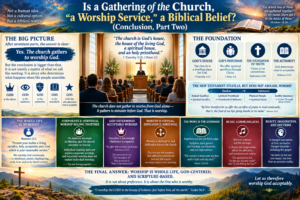
This brings the whole series back to its original question. Is a gathering of the church a worship service?
Yes, because the church is God’s house.
Yes, because the church is God’s spiritual house.
Yes, because the church is God’s holy priesthood.
Yes, because the church offers spiritual sacrifices.
Yes, because the church offers praise to God.
Yes, because Christ is the Head of His church.
Yes, because the assembly comes before God through Christ.
Yes, because the church is commanded to assemble.
Yes, because worship is not abolished by the New Covenant.
Yes, because Christ did not replace worship with mere religious education.
The conclusion has an even more important implication. Because the assembly is worship, the church must take worship seriously, not to say that the assembly is not worship. The answer is to return worship to God. God must be the object, the audience, the authority, and the standard. He must be the One whose pleasure determines whether the offering is acceptable.
What Have We Learned?
We have learned that the church gathering is not fundamentally about what man gets. It is about what God’s people offer to God. The church is not merely a collection of individuals but Christ’s assembled body, God’s house and spiritual temple, and a holy priesthood.
We have learned that believers offer spiritual sacrifices through Jesus Christ, singing is part of that worship, and that congregational praise is directed primarily to God. Edification accompanies worship without redefining its object, and the human response does not authenticate worship.
We have learned that worship must be offered by qualified worshipers through Christ and according to God’s revealed will. Biblical worship is reverent and joyful, solemn and heartfelt, spiritual and truthful, orderly and alive. Music is not inherently worship, but when music is brought into worship, its purpose, object, communication, and fitness matter.
We have learned that music is not simply a neutral container for words. Beauty cannot be reduced to personal taste. Fallen perception can distort beauty. Distorted beauty can distort desire, distorted desire can distort judgments of goodness, and distorted judgments of goodness can make falsehood easier to accept.
We have learned that falsehood can lead to false worship, and false worship can produce false doctrine and moral compromise. Experience must submit to revelation. Pragmatism cannot determine truth. The world’s wisdom is not God’s wisdom. True believers must discern culture rather than blindly adopting it. Modernism and postmodernism both displace God’s revealed authority in different ways. Christianity is not one compartment of life — it is total truth.
The Church Must Worship God on God’s Terms
The church therefore does not gather merely to create an experience, satisfy an audience, produce a particular emotional state, demonstrate the creativity of its musicians, showcase the personality of its preacher, or achieve numerical success. It gathers before God.
The church comes through Christ, in faith and holiness, and under the authority of Scripture. It comes to offer praise, thanksgiving, prayer, obedience, preaching, giving, the ordinances, and the other acts Christ has appointed for His church. And the church comes for God’s glory.
The fundamental question, then, is not: “What kind of worship service do I prefer?” It is: “What kind of worship does God receive?” That question changes everything. It moves the church from preference to revelation, from taste to truth, experience to scripture, pragmatism to obedience, man to God, the world to holiness, performance to priestly service, entertainment to worship, and from the imagination of man to the revelation of God.
That is why the assembled church is a worship service. Not because men decided to call it one. Not because tradition gave it that name, nor because worship is whatever feels spiritual. But because God has established His church, God dwells among His people, Christ is the Head of His church, His people are His priesthood, and He has commanded His redeemed people to draw near to Him through Jesus Christ and offer Him acceptable spiritual sacrifices. The final word belongs to God.
O worship the LORD in the beauty of holiness: fear before him, all the earth.
And:
Give unto the LORD the glory due unto his name; worship the LORD in the beauty of holiness.
The church gathers to worship. Let us therefore worship God acceptably.