Part One Part Two Part Three Part Four Part Five Part Six Part Seven Part Eight Part Nine Part Ten Part Eleven Part Twelve Part Thirteen Part Fourteen Part Fifteen Part Sixteen
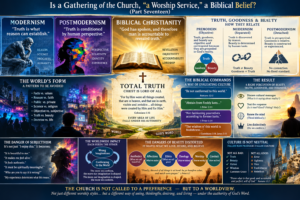 Modernism says, “Truth is what reason can establish.” Postmodernism says, “Truth is conditioned by human perspective.” Neither of these accepts, believes, or restores the authority of God’s revelation over man’s perception. Postmodernism is not a correction or return to premodern Christianity but a further development of the displacement of objective authority. Modernism said: “I can know truth without God.” Postmodernism says: “There isn’t a neutral standpoint from which anyone can claim absolute truth.” Biblical Christianity says something different: God has spoken, and therefore man is accountable to revealed truth.
According to a premodern Christian framework, truth, goodness, and beauty are each objective. The three correspond because they are grounded in God’s reality. According to modernism, truth increasingly becomes something human reason discovers and beauty increasingly becomes something human taste determines. With the postmodern framework, truth is perspectival, goodness is relative to communities and identities, and beauty is whatever the observer or culture constructs/experiences as beautiful. This detaches truth, goodness, and beauty from one another.
If someone encounters something that produces a powerful aesthetic or emotional response, an objective biblical framework tests the response: Is it true? Is it good? Is it fitting? Is it holy? Does it correspond to God’s revelation? Under subjectivism, someone invokes these instead, related to beauty: “It is beautiful to me.” “It makes me feel alive.” “It feels authentic.” “It must be spiritually meaningful.” “Who are you to say it is wrong?” Further than saying, “I enjoy this,” he says, “My experience of this determines what this means.”
“Be Not Conformed to This World” Assumes That the World Has a Form
Through the Apostle Paul, God commands (Romans 12:2):
And be not conformed to this world: but be ye transformed by the renewing of your mind, that ye may prove what is that good, and acceptable, and perfect, will of God.
Paul does not merely say, Do not sin. He says, “Be not conformed.” Conformity means taking a form or pattern from something outside oneself. The Christian is therefore not supposed to receive his pattern of thinking, desiring, evaluating, or living from “this world.” And notice what follows: “that ye may prove what is that good, and acceptable, and perfect, will of God.” An objective good and an objective will of God are the standard against which conformity is measured. So Romans 12:2 gives us a worldview command:
World’s pattern ≠ God’s pattern.
And the means of resisting the world’s pattern is: “the renewing of your mind.” That is epistemological before it becomes behavioral. Modern and postmodern relate to “the world,” the worldly mindset or worldview that under girds the culture, the form or pattern against the will of God.
“Abstain from Fleshly Lusts” Means that Desire Itself Cannot Be Trusted As an Authority
As Paul commanded, Peter does in 1 Peter 2:11:
Dearly beloved, I beseech you as strangers and pilgrims, abstain from fleshly lusts, which war against the soul.
Peter does not tell Christians merely to abstain from bad actions. He tells them to abstain from lusts. Why? Because desire itself can be an enemy. The fallen person can look at something, experience something, desire something, and conclude: “Because I desire this, it must be good.” Peter says the opposite precisely. Your desire wars against your soul. Feeling strongly about something does not authenticate it. Finding something attractive does not establish its goodness. Subjective aesthetic experience is not the final judge.
1 Peter makes the cultural application even more explicit. Peter says (1:14):
As obedient children, not fashioning yourselves according to the former lusts in your ignorance:
The Christian does not let his former desires fashion his present life. The pattern formerly received conflicts with the pattern or form now received from God. Peter continues:
But as he which hath called you is holy, so be ye holy in all manner of conversation.
The standard is not: “What does my culture consider acceptable?” The standard is: “He is holy.” God’s character establishes the pattern.
A Massive, Although Subtle, Way Professing Believers Conform to and Fashion According to the World
For a while, professing Christians often divide life into a supposedly “spiritual” realm and a supposedly “secular” realm. Christianity is a comprehensive worldview. Biblical truth applies to the whole of reality. As the hymn lyrics communicate, “This is our Father’s world.” The modern Western world increasingly separates reality into compartments: facts vs. values, reason vs. faith, public vs. private, science vs. religion, objective vs. subjective, truth vs. beauty, and doctrine vs. life
Biblical Christianity cannot and will not accept the proposition: “Christianity is true for your religious life, but it doesn’t determine how you understand art, science, politics, economics, sexuality, education, music, or culture.” Since God is Creator, no part of reality is outside His Lordship. Since Christianity is true, it cannot and will not govern only salvation, church attendance, prayer, Bible reading, and private morality. Christianity gives us a comprehensive account of reality.
Therefore, God’s truth bears upon education, family, sexuality, economics, government, science, philosophy, art, literature, music, entertainment, architecture, dress, language, technology, work, recreation, and worship. This is not because the Bible gives a specific verse for every cultural artifact, but because everything exists within God’s created and moral order. That is the meaning of a biblical worldview.
“The Wisdom of This World” Is Explicitly Rejected As a Competing Worldview
Paul says (1 Corinthians 3:19):
For the wisdom of this world is foolishness with God.
James goes even further (James 3:15):
This wisdom descendeth not from above, but is earthly, sensual, devilish.
James does not say merely: “Some of this world’s ideas are mistaken.” He identifies a category of “wisdom” that has an origin, character, and direction contrary to God’s wisdom: earthly, sensual, and devilish. That gives an objective category for cultural analysis. The Christian doesn’t have to ask merely: “Do I personally like this cultural idea?” He can ask: Where does this way of thinking lead? What view of man does it assume? What view of God does it assume? What does it call good? What does it call beautiful? What does it encourage people to love? What does it make seem normal?
James’s description “sensual” is relevant because the biblical conflict is not merely intellectual. The world’s wisdom appeals to the senses and desires. That connects directly to the “lying eyes” theme I introduced earlier. The eyes perceive, affections respond, judgment follows, and then action comes afterward. What repeatedly appeals to the senses can train the affections.
People don’t merely think their worldview. They also imagine it, feel it, love it, and eventually live it. That means art can function as a kind of worldview catechism. A proposition says: “This is what reality is.” An artistic form can make that reality feel normal, attractive, compelling, desirable, glorious, ridiculous, oppressive, liberating, or beautiful. When a culture repeatedly makes something to be beautiful, it does more than entertain people. It disciples their affections.
Modernism and Postmodernism Are Rival Stories to God’s
Modernism and postmodernism aren’t merely philosophical ideas sitting in universities. They become ways of interpreting the whole world. With modernism, autonomous reason explains reality, and with postmodernism, no neutral, universal perspective interprets reality. According to biblical Christianity, God created reality, revealed truth, and His revelation provides the authoritative framework to interpret everything. It isn’t just another opinion inside the marketplace of perspectives. It claims something about the nature of reality itself.
Music as preference is worldview fragmentation. This false way of thinking says that Christianity governs doctrine, but music belongs to personal taste. Also: Christianity governs morality, but aesthetics belongs to culture. Or: Christianity governs the church, but marketing determines how the church should attract people. The Christian worldview cannot and will not live with those divisions. Since God is Lord of all truth, then the question becomes:
What does God’s truth require of us in every area of life?
That does not mean Scripture contains a direct verse specifying every artistic technique or musical chord. It means every human activity exists inside God’s created and moral order and therefore must be evaluated consistently with biblical revelation.
Holiness Cannot Be Separated from Aesthetics
If beauty is merely subjective, aesthetic judgments seem harmless, but if beauty participates in our perception of reality, then what we repeatedly call beautiful affects what we desire. Then what we desire affects what we call good, and what we call good affects what we believe. Finally, what we believe affects how we worship, and what we worship affects how we live. That doesn’t mean every aesthetic choice produces a theological error. Aesthetic formation, though, causes worldview formation.
Romans 1 shows a biblical picture of “worldview disintegration.” How does it happen? It starts with someone who knows God, not necessarily in a saving way, especially the one who turns from Him. Without contentment in or with that knowledge of God, he becomes vain in his imagination. This results in changing the truth of God into a lie, finishing with worshiping and serving the creature rather than the Creator. Music and other art can and often does shape a false god in the imagination to replace the one and only true One.
Culture Not Neutral
Fallen Man Produces Fallen Culture
Culture is not itself synonymous with evil. God created man to cultivate the earth. Human beings produce language, music, architecture, technology, literature, government, craftsmanship, and countless other cultural goods. The problem is that fallen man produces culture from within a fallen worldview. Therefore, cultural artifacts can contain truth and error, beauty and ugliness, virtue and vice, wisdom and foolishness, and common grace and rebellion. Christians aren’t commanded to hate everything produced outside Christianity. They are commanded to discern.
Romans 12:2 ends with “that ye may prove what is . . . good, and acceptable, and perfect, will of God.” That is an objective discernment process. If a culture says: “This is beautiful,” the Christian asks: “Beautiful according to what standard?” When culture says: “This is good,” the Christian asks: “Good according to whose definition?” Culture will say: “This is authentic,” and the Christian asks: “Authentic to what?” If culture says: “This is freedom,” the Christian asks: “Freedom for what purpose?” Culture might say, “This is love,” and the discerning Christian asks: “Does this correspond to biblical love?”
Discerning Culture
Culture will say, “This is art,” but the Christian asks: “What vision of reality does this art communicate?” The renewing of the mind that enables a believer not to conform to the world occurs through discernment. False imaginations and acts of conforming to them are insatiating. The two feed off each other. Wrong imaginations come through conforming to the world. Conforming to the world fuels wrong imaginations.
Culture rarely asks Christians to deny Christ outright at the beginning. It can begin much more subtly. It runs the gamut from accommodation to acceptance to appreciation to adaptation to advancement. What starts as an aesthetic change turns into moral and then doctrinal change. “Be not conformed to this world” is such a comprehensive command. Conformity does not begin merely when you commit the final act. It can begin when you accept the world’s categories for judging reality.
More to Come