Part One Part Two Part Three Part Four Part Five Part Six Part Seven Part Eight Part Nine Part Ten Part Eleven Part Twelve Part Thirteen Part Fourteen Part Fifteen Part Sixteen Part Seventeen
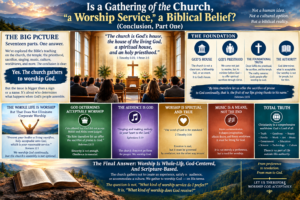 Seventeen parts is a long way to go to answer what might appear to be a simple question: Is a gathering of the church “a worship service”? After working through the biblical theology, the nature of the church, the temple, priesthood, sacrifice, singing, music, aesthetics, experience, pragmatism, culture, modernism, postmodernism, and worldview, the answer should now be clear.
Yes. The church gathers to worship God.
But the conclusion is bigger than that sentence.
The issue is not merely whether someone should put “Worship Service” on a church sign. The deeper issue is whether the church believes that God determines what happens when His people assemble before Him. The question is whether God is the object, God is the audience, God is the authority, God is the standard, and God is the One who determines whether what His people offer is acceptable.
The series began with the claim that the New Testament church gathering is not merely an opportunity for Christians to receive something. It is an assembly of God’s people before God. The church is not merely a classroom, a fellowship hall, an evangelistic meeting, a support group, or a religious event. The church is God’s house, the house of the living God, a spiritual house, and an holy priesthood.
Paul says (1 Timothy 3:15):
But if I tarry long, that thou mayest know how thou oughtest to behave thyself in the house of God, which is the church of the living God, the pillar and ground of the truth.
Peter says (1 Peter 2:5):
Ye also, as lively stones, are built up a spiritual house, an holy priesthood, to offer up spiritual sacrifices, acceptable to God by Jesus Christ.
Those two passages establish an essential connection. The church is God’s house, and the church is God’s priesthood. A priesthood exists to minister before God. The church therefore does not merely assemble to receive ministry from God or from one another. The church assembles to minister before God. That is worship.
The New Testament Does Not Abolish Worship
One of the most important conclusions of this series is that the New Testament (NT) does not destroy the Old Testament (OT) category of worship. It fulfills it. Christ fulfills the priesthood, the sacrifices, the tabernacle and temple shadows, and the covenant promises. Yet the fulfillment does not result in the disappearance of worship. Instead, worship moves from shadow to substance.
The animal sacrifice becomes the spiritual sacrifice. The Levitical priesthood gives way to the priesthood of believers. The physical temple gives way to the spiritual house. The earthly sanctuary gives way to access to God through Jesus Christ. The old covenant congregation gives way to Christ’s church. The essential reality remains. God’s people come before God through the means God has appointed to offer Him what He accepts. Hebrews 13:15 says:
By him therefore let us offer the sacrifice of praise to God continually, that is, the fruit of our lips giving thanks to his name.
The writer does not say that Christ fulfilled sacrifice and therefore there is no more sacrifice. He says, “Let us offer,” not that Christ fulfilled worship and therefore worship is finished. He tells redeemed people to offer the sacrifice of praise. The offering changed, but the worship continues.
The Whole Life Is Worship, But That Does Not Eliminate Corporate Worship
Another important distinction emerged early in the series. Romans 12:1 teaches that the Christian’s whole life belongs to God:
I beseech you therefore, brethren, by the mercies of God, that ye present your bodies a living sacrifice, holy, acceptable unto God, which is your reasonable service.
The believer worships continually. He worships God through obedience, prayer, thanksgiving, holiness, faithfulness, work, generosity, love, and every other lawful activity performed for the glory of God. But this does not mean that the church’s assembly is not worship.
A Christian worshiping God on Monday does not make Sunday worship unnecessary. Just because he prays privately does not make corporate prayer unnecessary. The reality that he sings in his home does not make congregational singing unnecessary. Individual worship and corporate worship are not competing categories. The individual Christian belongs to the body. The body assembles as God’s house and priesthood. Corporate worship therefore does not replace individual worship, and individual worship does not replace corporate worship. The two belong together.
In fact, corporate worship governs and forms individual worship. When the church assembles, it hears the Word publicly, prays, sings, gives, observes the ordinances, receives preaching, exhorts one another, and submits itself to the authority of God’s Word. What happens in the assembly shapes what happens when the believer leaves it. The church gathering therefore is not one optional devotional exercise among many. It is the assembly of Christ’s church.
God Determines Acceptable Worship
As its revealed truth unfolds, scripture shows worshipers do not determine whether worship is acceptable. God does. Cain offered to God, but God did not accept Cain’s offering. Nadab and Abihu offered before the LORD, but they offered “strange fire,” “which he commanded them not.” Israel assembled before God many times, but God repeatedly rejected their worship because their lives and their worship contradicted His revealed will. The prophets repeatedly expose this problem.
The question was never simply: “Are you worshiping God?” Instead, it was: “Are you worshiping God as God has commanded?” That distinction destroys the idea that sincerity by itself authenticates worship. A worshiper can be sincere and wrong, a congregation enthusiastic and wrong, a church large and wrong, a service emotionally powerful and wrong, and a musical presentation can be beautiful to human beings and still be unacceptable to God.
The final question is not: “Did we enjoy it?” Nor: “Did people respond?” Nor: “Did visitors like it?” Nor: “Did we feel God’s presence?” The question is: Does God receive it?
God Is the Audience
The Bible overwhelmingly directs sacred praise toward God. The Psalms repeatedly say, “sing unto the LORD,” “praise the LORD,” “bless the LORD,” and “make a joyful noise unto God.” The NT continues in the same direction. Paul says (Ephesians 5:19): “Singing and making melody in your heart to the Lord.” And (Colossians 3:16): “Singing with grace in your hearts to the Lord.” Hebrews 13:15 calls congregational praise “the sacrifice of praise to God.”
The congregation hears the singing. Saints are edified. An unbeliever may be convicted. But those effects do not change the object of the offering. The church is not performing worship for the congregation. It is worshiping God. This distinction is enormously important because once the congregation becomes the functional audience, the question naturally changes from “Does God accept this?” to “Do people like this?”
Once people become the audience, people become the judge; and once people become the judge, their response becomes the standard. When their response becomes the standard, music becomes increasingly functional. It must attract, excite, produce participation, create an atmosphere, generate emotion, keep people coming, and then produce results. The offering to God shifted to a product for man.
Edification Is Real, But It Does Not Change the Object of Worship
God commands the church to edify. His Word teaches, exhorts, reproves, corrects, comforts, and strengthens. Congregational singing can teach truth, encourage the saints, and strengthen faith. It can cause believers to remember scripture and rejoice in God’s goodness. But a beneficial effect does not redefine the object of the offering. An OT sacrifice benefited the worshiper, but that did not make the worshiper the recipient of the sacrifice. Likewise, congregational singing benefits the congregation while remaining directed to God.
The distinction is simple: Worship is vertical in its direction. Edification is horizontal in its effect. The two are not enemies. Indeed, faithful worship will edify, but edification should not become the reason that worship ceases to be worship.
Worship Must Be Both Spiritual and True
Biblical worship is not emotional deadness. The NT church worshiped with gladness, and the apostles rejoiced in suffering. Paul and Silas prayed and sang praises to God in prison. The Psalms are filled with joy, sorrow, wonder, fear, thanksgiving, longing, celebration, confession, and exuberant praise. The issue is therefore not: Emotion or no emotion? The issue is: What governs the emotion?
The biblical order is:
revelation → truth → faith → rightly ordered affection → response.
The counterfeit reverses that:
stimulus → sensation → excitement → interpretation → “God must be in this.”
The Bible never teaches that intensity authenticates worship. A person can feel something intensely and still be wrong, feel nothing and still obey God, experience tremendous joy because he has apprehended the truth of God, or undergo tremendous excitement because a stimulus has produced a physical and emotional response. Those are not the same thing. Biblical worship does not eliminate emotion. It puts emotion in its proper place.
The Word of God Is the Standard
Peter commands believers (1 Peter 2:2):
As newborn babes, desire the sincere milk of the word, that ye may grow thereby.
The Word is sincere. It is pure. It is not adulterated. The believer does not need to manufacture an experience to authenticate it. Peter makes a similar point in 2 Peter 1. On the Mount of Transfiguration, he personally witnessed Christ’s majesty and heard the voice from heaven. Yet Peter says: “We have also a more sure word of prophecy.”
Genuine experience did not become more authoritative than God’s revealed Word. Therefore, when experience and Scripture conflict, scripture does not need to be corrected by experience. Scripture serves to correct experience.
This is the difference between biblical faith and experiential pragmatism. The Christian does not say: “I know God approved it because I felt something.” He says: “God has spoken, and therefore I will judge my experience by what He has said.”
The Distorted Mirror
The problem with fallen man is not that reality has disappeared. God’s creation remains God’s creation. Truth remains true. Good remains good. Beauty remains beauty insofar as it corresponds to reality, goodness, order, and God’s character. The problem is man’s perception. The world, the flesh, lust, prior conditioning, false teaching, Satan’s deception, and sinful desire can distort the way man interprets reality.
A man can look into a distorted mirror and honestly say: “But I can see myself.” Yes. He can see himself. But he does not necessarily see himself accurately. Likewise, a person can honestly say: “I experienced this.” The experience may be genuine. But his interpretation of the experience may be false. The answer is not to stare harder into the distorted mirror. Instead, it is to have an external standard by which the distortion can be identified. That standard is God’s Word (Psalm 119:105).
Thy word is a lamp unto my feet, and a light unto my path
Beauty Is Not Mere Preference
Truth answers, in a practical sense, what is real. Goodness answers what is right and worthy. Beauty answers what is fitting, excellent, desirable, and worthy of delight. These belong together because they are grounded in God’s reality. Sin, however, can separate them in man’s perception.
Eve saw that the forbidden tree was pleasant to the eyes. The tree had not changed. God’s command had not changed. Reality had not changed. Her perception had become disordered. Jonah describes those who (2:9) “observe lying vanities.” The lie does not always begin by looking ugly. Sometimes the lie becomes powerful because it looks beautiful. Something can become attractive before it becomes intellectually defensible.
A person can begin with “I like this,” which turns to “There is something beautiful about it,” then, “Surely something this beautiful cannot be wrong,” “Perhaps the Bible needs to be understood differently, then “God knows my heart, and finally, “We shouldn’t be legalistic.” Eventually, an aesthetic judgment has become a theological conclusion and then a moral practice. That is why the corruption of beauty is not merely an aesthetic problem. It can become an epistemological, theological, and moral problem.
Music Is Not Worship Merely Because It Is Music
Genesis 4 helps establish another important distinction. Jubal is “the father of all such as handle the harp and organ.” Music therefore exists as a legitimate part of human culture outside specifically prescribed worship. Music itself is not synonymous with worship. But that also does not mean that every musical form is equally appropriate for worship. Music is a means.
Worship is a particular God-directed use of means. The question is not “Is music neutral?” nor “Is this music used somewhere in the world?” The question is: What does this music communicate, and is that communication fitting for the worship of God? Revelation 18:22 gives a striking canonical picture. Babylon’s musicians and musical sounds disappear when Babylon is judged.
And the voice of harpers, and musicians, and of pipers, and trumpeters, shall be heard no more at all in thee.
The passage does not say that every musical form ever used by unbelievers will disappear. However, it does show that the music associated with fallen Babylon belongs to a passing world system. The church therefore does not take its worship standard from Babylon. It takes its standard from God.
Music Communicates
Music is not a dictionary. A particular chord does not mean “holiness” nor does a drumbeat necessarily mean “fornication.” Music, though, communicates through qualities, associations, affect, manner, movement, and expression. A person can hear anger without someone saying, “I am angry,” can see sensuality without a caption explaining it, and can recognize tenderness, dignity, frivolity, aggression, solemnity, joy, disorder, restraint, and other qualities without receiving a verbal definition.
Art communicates because man lives in an ordered creation. Therefore, the question in worship is not merely whether the words are orthodox. The whole communicative act matters. A congregation may say, “God is holy,” while the manner in which it communicates that truth can suggest casualness, sensuality, entertainment, theatricality, or self-centered emotionalism.
The issue is correspondence. Does the form fit the truth, the manner fit the object, and the expression fit the God being worshiped? That is why Scripture says: “O worship the LORD in the beauty of holiness.” The question is not: “Is this my favorite style?” The question is: “Is this fitting for God?”
The First and Second Commandments Remain Relevant
The First Commandment says (Exodus 20:3): “Thou shalt have no other gods before me.” The Second Commandment prohibits making an image for worship. The danger is therefore not limited to physically bowing before a statue. Israel could retain the name of the LORD while altering the representation of Him. Aaron could say: “To morrow is a feast to the LORD.” Yet Israel had constructed the golden calf. They had not merely changed the vocabulary. They had changed the conception of God.
That means Christian worship can retain orthodox words while still communicating an unorthodox conception of God. The question becomes: Which God is being worshiped? Not merely: “What words are we singing about God?” The true God is the God revealed in scripture, who is holy, glorious, majestic, sovereign, merciful, righteous, transcendent, near, and worthy of fear, joy, love, thanksgiving, obedience, and praise. Worship must correspond to Him as He has revealed Himself to be.
More to Come