Part One Part Two Part Three Part Four Part Five Part Six Part Seven Part Eight An Aside (Between Parts Eight and Nine) Part Nine Part Ten Part Eleven
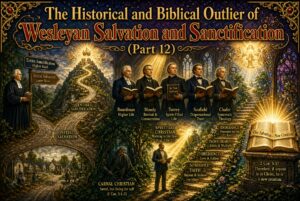
John Wesley changed the doctrine of salvation, and the effects reached far beyond Methodism. Fundamentally, he divided the Christian life into an initial saving work and a subsequent one of entire sanctification. Later movements modified the second tier while retaining much of the structure. Evangelicalism developed another version: a distinction between carnal Christian and spiritual Christian. Simultaneously, it weakened the doctrine of eternal security. The first allowed a professing Christian to remain spiritually deficient without losing his salvation, and the second made that salvation permanently secure regardless of that deficiency.
The Evangelical Adaptation
The Two Tiers
The evangelical version retained the basic distinction while changing the categories. At a first tier, God could save a person, and yet he starts and remains a “carnal Christian.” This same person might decide later to follow Jesus at a crisis moment, which begins his second-tier experience as a “spiritual Christian.” Lewis Sperry Chafer became particularly influential in systematizing these two tiers. His carnal Christian could claim a profession of faith while living in a condition of spiritual defeat.
The inferiority of the first-tier would not at all alter the status of eternal security for the “carnal Christian.” The first tier was therefore permanently secure. The second tier described a higher quality of Christian living. Wesley’s two tiers navigated into a large contingent of evangelicals and fundamentalists through to Chafer and those like him primarily through a connection with the Keswick Movement.
Boardman, Moody, Torrey, Scofield, and then Chafer
William Boardman’s The Higher Christian Life (1858) was particularly important because it supplied non-Wesleyan language for a Wesleyan-type subsequent experience. The emphasis increasingly moved away from eradication of sin toward victorious living, Spirit empowerment, and dependence upon Christ. His ministry in England coincided with the great evangelistic campaigns of D. L. Moody and Ira Sankey in 1873–74. Moody himself adopted the language of a subsequent “endowment with power,” describing a distinct experience of divine empowerment after conversion.
R. A. Torrey then became an especially important transmitter of this emphasis through the Moody Bible Institute and the wider Bible-conference movement, teaching a distinct work of the Holy Spirit connected with power for service. Thus Boardman supplied an important Higher Life formulation, while Moody and Torrey helped carry the subsequent-experience emphasis into the broader non-denominational evangelical world. C. I. Scofield then served as the critical bridge to Lewis Sperry Chafer.
Scofield was pastor of Moody’s church in Northfield and became closely associated with the Northfield Bible-conference world. Chafer came to Northfield in 1901 and came under Scofield’s influence; the two subsequently worked together for many years, conducting Bible institutes and developing a close teaching relationship. His earlier exposure to Moody and then Scofield created the conditions in which he adopted and transformed the second-blessing/Higher Life model into his distinctive doctrine of spirituality.
Scofield Reference Bible and Chafer’s He That Is Spiritual
Scofield’s 1917 Reference Bible had already articulated the “carnal Christian” distinction, and Chafer’s He That Is Spiritual (1918) expanded it into a systematic doctrine: the saved person could be either “carnal” or “spiritual,” with a significant transition possible from the former to the latter. Chafer therefore did not simply reproduce Wesley; he translated the older Wesleyan/Higher Life structure into a new evangelical vocabulary — carnal versus spiritual, Spirit-filled versus unfilled, and deliverance/victory versus ordinary Christian living.
The carnal-Christian doctrine raises a question about regeneration. Paul says in 2 Corinthians 5:17, “Therefore if any man be in Christ, he is a new creature.” Regeneration produces new life. The Christian still sins. He still struggles and still needs correction, but regeneration does not leave a person permanently unchanged. The question therefore becomes important: What does saving faith produce? The New Testament (NT) repeatedly connects salvation with a changed direction of life.
The “Eternal Security” Guaranteed to First-Tier Carnal Christian
Jesus says in John 15:4, “Abide in me, and I in you.” He speaks of remaining in Him and bearing fruit. The NT repeatedly uses the same kind of language. The believer continues, abides, endures, overcomes, walks in the light, and keeps the faith. These things do not earn salvation. They demonstrate the reality of saving faith. God preserves His people through the continuing work of grace in them
The Book of Revelation makes this especially clear. Christ repeatedly addresses the churches with the command to overcome (Revelation 2:7): “To him that overcometh will I give to eat of the tree of life.” The Christian life therefore cannot be reduced to a past transaction that makes the subsequent life irrelevant. Overcoming does not mean sinless perfection. It means that the believer continues with Christ. God’s preserving grace does not produce indifference toward Christ. That is why eternal security should not be detached from the New Testament’s teaching about continuing faith.
The Past Transaction Becomes the Foundation
Once assurance becomes centered almost entirely upon a past decision, the question changes.
Did you accept Christ?
Did you pray the prayer?
Did you walk the aisle?
Did you make a decision?
If the answer is yes, then the person is assured that he is saved. The problem is not that the past matters. It does. The problem comes when the past decision becomes sufficient evidence regardless of what follows. The NT does not tell believers merely to remember what they once did. It also tells them to examine themselves, continue in the faith, abide in Christ, walk in the light, obey Christ, and demonstrate the reality of their faith. John writes (1 John 2:3):
And hereby we do know that we know him, if we keep his commandments.
John does not make obedience the basis upon which someone earns salvation. He makes obedience evidence that a person knows Christ. That distinction is critical.
Matthew 13 and the Problem of Superficial Response
Jesus’ parable of the soils also creates difficulty for a system that treats an initial response as conclusive evidence of regeneration. Some receive the Word with joy but have no root. Others receive the Word but become unfruitful because of the cares of the world and the deceitfulness of riches. The good ground bears fruit. Jesus therefore directs attention beyond the initial response to what the Word produces. A profession is not the same thing as bearing fruit. An emotional reception is not the same thing as enduring faith.
This becomes especially significant in revivalism. Revival meetings emphasized decisions. People came forward. They prayed. People professed faith. They were counted. But some disappeared. Some showed little evidence of change. The system needed an explanation. The carnal Christian supplied one. A person could have made a genuine decision and remain spiritually deficient. He could still be saved without being “spiritual.” This allowed the original decision to remain intact even when the subsequent life raised serious questions.
The second tier then became the practical answer. Rededication. Surrender. Revival. Spirit-filling. Fresh commitment. The system could explain the deficiency without revisiting the original profession. This helps explain the importance of re-dedication in revivalist Christianity. A person could have been saved years before and then come forward again. He could rededicate his life, surrender himself to God, seek the fullness of the Spirit, ask God to use him, or make another decision. Structurally, this is the earlier Wesleyan pattern. The later experience, something additional after conversion, was presented as necessary for victorious Christian living, not for salvation.
The Incompatible Engines
Two ideas now operate together. The first says: You are eternally secure because you once believed. The second says: You need a subsequent experience to live victoriously and effectively. The first minimizes the evidential significance of the believer’s subsequent life. The second continually seeks evidence of spiritual vitality through experience and results. This produces an unstable combination.
If the believer’s present life does not matter to his salvation, why does he need another experience? Because he needs victory. Why does he need victory? Because the first tier is insufficient for practical Christian living. But if the first tier is insufficient for practical Christian living, why is the person already regarded as fully secure? The system can answer these questions only by separating salvation from the Christian life more sharply than Scripture does.
The two-tier structure repeatedly relocates things that scripture closely connects with salvation. Repentance can become something subsequent. Submission to Christ is discipleship. Overcoming relates only to rewards. Fruit becomes evidence only of a higher Christian life. Surrender is a second decision. Holiness is the Higher Life. Assurance is certainty about a past decision. Eventually, a person can possess the label “saved” while lacking what the NT associates with true conversion. This is not merely a disagreement over terminology. It concerns the nature of salvation itself.
Salvation Is Not a Two-Tiered Product
Biblical salvation does not come in levels. God saves the sinner, regenerates, gives His Spirit, sanctifies, and begins conforming the believer to Christ. The Christian then grows. He obeys, overcomes, abides, and endures, and these belong to the one Christian life. The believer does not graduate into another category of Christianity. Proceeding from the Wesley two-tiered structure and its proceeding iterations, evangelicalism developed the carnal Christian. “Once saved, always saved” then made the first tier permanently secure, even when the Christian’s life appeared deficient.
But the second tier did not disappear. It continued through re-dedication, surrender, Spirit-filling, revival, anointing, power, and repeated spiritual experiences. The system continually needed something more because the first tier wasn’t really salvation. The NT presents something different. The Christian life is not a ladder of spiritual experiences. It is a life of faith, obedience, growth, endurance, and conformity to Jesus Christ.
The next question therefore reaches even deeper. If the first tier reduces to a decision, and the second tier supplies its shortcomings by re-dedication, revival, Spirit-filling, or another experience, what happens when the methods used to produce those experiences become part of the definition of Christianity itself? At that point, the history moves from the doctrine of the carnal Christian into the methods of modern evangelical conversion and worship. This, in fact, dovetails with my long, recent series on worship in the church.
More to Come