Part One Part Two Part Three Part Four Part Five Part Six Part Seven Part Eight An Aside (Between Parts Eight and Nine) Part Nine Part Ten Part Eleven Part Twelve
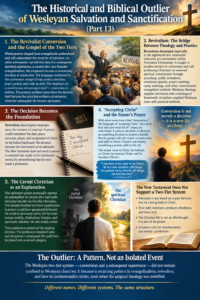 The Revivalist Conversion and the Gospel of the Two Tiers
Wesleyanism shaped how evangelicals understood and still understand the doctrine of salvation. As earlier movements carried the idea of a subsequent spiritual experience, a second tier, into broader evangelicalism, the emphasis became a momentary decision at conversion. Language conformed to the movement: accept Christ, make a decision, pray a prayer, and walk an aisle. The emphasis on a moment was not wrong in itself — conversion is definite. A sinner must repent and believe. The primary problem came when the decision itself became the principal evidence of salvation, while the subsequent life became secondary.
Revivalism developed especially in the eighteenth and nineteenth centuries as a movement within Protestant Christianity. It sought to awaken sinners to conversion and call professing Christians to renewed spiritual commitment through preaching, public invitations, emotional appeals, prayer meetings, camp meetings, and other concentrated evangelistic methods. Wesleyan theology supplied revivalism with an important theological framework for understanding conversion, subsequent spiritual experience, holiness, and Christian commitment. In contrast, revivalism supplied Wesleyan ideas with practical methods for producing and identifying those experiences in public ministry.
This development provided an important setting for the evangelical version of the two-tier system. A person could make a decision that regarded him as saved. If his life afterward did not correspond to his profession, the system had another category available. He was a carnal Christian.
The Decision Becomes the Foundation
Revivalism placed great emphasis upon the moment of response. A person could remember the date, place, occasion, prayer, and acceptance of Christ. As he looked backward, the decision became the benchmark of his salvation. Again, there is nothing inherently wrong with remembering the time when one believed. The problem comes when the past decision becomes more authoritative than the subsequent life. The New Testament (NT) does not teach a person to establish the reality of his Christianity merely by remembering that he once made a profession.
John gives another kind of evidence in his first epistle: the life, light, and love of the true believer. This is in fact how he knows he has eternal life. John does not say that keeping Christ’s commandments earns salvation, but that obedience evidences that a person knows Christ. The NT therefore does not isolate conversion from everything that follows. Truly saving faith continues, produces obedience, and bears fruit. The beginning matters, but the beginning does not render the rest of the Christian life irrelevant.
“Accepting Christ” and the Sinner’s Prayer
With what some have titled “decisionism,” the language of “accepting Christ” also arose that obscures what the NT means by conversion. A person can think of salvation as something he does to receive a benefit. He accepts, decides, prays, settles the matter, and then he possesses salvation. But the gospel calls the sinner to repentance and faith in Christ. Christ is not merely something a person adds to his life. The sinner turns to Christ; he believes on Christ; he receives Christ; and he becomes Christ’s. Paul describes the result (2 Corinthians 5:17):
Therefore if any man be in Christ, he is a new creature: old things are passed away; behold, all things are become new.
The emphasis is not merely upon what happened at a particular moment, but upon what God has made the person to be in Christ. Conversion begins a new life. It does not merely establish a permanent record of a past decision. The same problem can arise with the sinner’s prayer. The Bible commands sinners to repent and believe, and even though it also. But Scripture never presents a particular formula of words as the instrument that guarantees regeneration.
A person can pray words without believing. He can make a profession without possessing Christ. The danger, therefore, is when prayer becomes the assurance rather than Christ and the evidence of His saving work. Someone asks: “Did you pray the prayer?” “Yes.” “When?” “I remember the date.” “Then you are saved.” The conversation can end there. But the NT does not end there. The question is not merely whether a person once said something, but whether he believes in Christ, which results in his continuing, the Word taking root, and his true, saving faith producing fruit.
The Carnal Christian as an Explanation
The revivalist system eventually needed an explanation for people who had made decisions but did not live like Christians. The carnal-Christian doctrine supplied one. A person could have genuinely believed. He could be genuinely saved. Yet he could remain worldly, disobedient, fruitless, and spiritually defeated. He was simply carnal. This explanation preserved the original decision. The profession remained valid, and the person’s subsequent life could then be placed into another category. He needed rededication, surrender, the fullness of the Spirit, victory, which meant becoming spiritual.
The system had therefore created a way to preserve salvation while explaining deficient Christianity. But this raises an important question. What happens when the deficiency becomes permanent? How long can someone remain carnal? How much disobedience can characterize a person who supposedly possesses the new life described in the NT? At what point does the explanation cease to describe Christian immaturity and begin to protect a questionable profession? Those questions cannot be answered merely by appealing to the date of a decision.
The Gospel of the Two Tiers
The earlier Wesleyan structure divided the Christian life into levels. The first level was conversion and the second was entire sanctification. Later movements changed the second level. The Holiness movement called it the second blessing. Keswick called it the Higher Life. Pentecostalism connected it with baptism in the Spirit and power. Evangelicalism increasingly described it as the spiritual or victorious Christian life. The vocabulary and the theology changed, but the basic structure remained.
A person is saved; then he needs something more: fullness, victory, surrender, power, the deeper life, or another experience. This is the gospel of the two tiers. Yet, the NT presents one saving work that produces one Christian life: one new birth, one Savior, one justification, one adoption, one Spirit, one standing in Christ, and one salvation. Then there is growth. The Christian grows in grace, knowledge, obedience, holiness, love, and in conformity to Christ. Growth does not mean that the believer moves from one kind of Christianity into another. It means that the life he received develops.
The NT certainly uses the language of fullness. Paul prays that believers might be “filled with all the fulness of God” (Ephesians 3:19). The problem is not the word “fullness.” The problem comes when fullness becomes a second salvation experience. Paul writes to people who are already in Christ. He does not tell them that some are genuine Christians and others have not yet entered Christianity’s fuller level. He prays that those already belonging to Christ will increasingly experience the reality of what God has given them. That is growth. It is not a second tier.
A “Second Christianity”
The NT does not present one group of genuine Christians who possess the Spirit and another group who have not yet received the Spirit. Paul says, “Now if any man have not the Spirit of Christ, he is none of his” (Romans 8:9). The Spirit belongs to the Christian life. Then the New Testament commands the believer, the completely saved person, to walk in the Spirit, be filled with the Spirit, yield himself to God, and obey scripture. These commands do not establish another category of Christian. They describe how Christians live.
Once Christianity becomes a series of spiritual grades, the believer continually looks for the next experience: Spirit fullness, another anointing, or another breakthrough. The Christian life becomes a succession of experiences. The NT instead presents a continuing walk in which the believer abides, endures, overcomes, or continues in the faith, all the while characteristically obeying and growing. These are not successive grades of salvation. They are characteristics of the one Christian life.
Danger of Successive Spiritual Grades
The two-tier system also changes the way Christians measure spiritual reality. If the first tier is conversion and the second tier is a deeper experience, then the believer naturally begins looking for evidence of the experience. Scripture directs believers back to faith, truth, obedience, fruit, endurance, and holiness. Experience has a place. It does not have authority to define Christianity. The Word of God does.
Jesus repeatedly emphasized fruit. He did not teach His disciples to identify spiritual levels by private experiences. He said: “Wherefore by their fruits ye shall know them” (Matthew 7:20). Fruit develops over time. That is precisely why fruit provides a better biblical category than spiritual grades. Fruit does not appear all at once. It grows. The Christian life therefore involves development. A believer may have much growth remaining. But the biblical answer is not another tier.
The Gospel Produces a New Life
The gospel does not merely produce a decision. It produces a new creature. The sinner believes. God justifies, regenerates, saves, gives His Spirit, and the believer begins a new life. That life must grow. Paul says (Ephesians 2:10):
For we are his workmanship, created in Christ Jesus unto good works, which God hath before ordained that we should walk in them.
The works follow God’s saving work. They do not complete a defective first tier. They manifest the life God has given. That is the biblical order. The Christian therefore does not need to ask: “Am I first-tier or second-tier?” He needs to ask: “Am I walking faithfully in the life God has given me?” He needs to repent when he sins, obey when God commands, grow when he is immature, persevere when trials come, pursue holiness, and bring forth fruit.
These are not requirements for entering a higher class of Christianity. They are the ordinary demands of Christian discipleship. The New Testament gives us one gospel. It does not give us two Christian lives. It gives us one Christian life that begins with new birth and continues in faith, obedience, growth, and perseverance. No secret Christianity waits for the believer when he discovers the right experience. No, there is one Christ, one gospel, one new birth, and one Christian life.
What About Unknown Sin?
Wesleyan theology distinguishes between known and unknown sin. A person may sincerely refrain from what he knows to be wrong while remaining ignorant of other sins. The Bible recognizes that people can be unaware of their sins. David prayed, “Who can understand his errors? cleanse thou me from secret faults” (Psalm 19:12). He also prayed (139:23-24):
Search me, O God, and know my heart: try me, and know my thoughts: and see if there be any wicked way in me, and lead me in the way everlasting.
David does not assume that his own consciousness already identified everything wrong in his heart. He asks God to search him. The existence of unknown sin, however, does not prove Wesley’s definition of perfection. Instead, it demonstrates the continuing need for God’s searching work in the believer. Conscious ignorance does not turn sin into righteousness. A person’s lack of awareness does not change the moral character of what God forbids. It does mean that the believer needs God’s Word to expose what he does not yet see. The biblical answer isn’t to redefine perfection so unknown sin won’t count against it.
The Christian’s Continuing Battle
Paul describes a genuine conflict with sin in Galatians 5:17:
For the flesh lusteth against the Spirit, and the Spirit against the flesh: and these are contrary the one to the other.
The answer is not despair. Neither is the answer a second salvation. Paul says, “This I say then, Walk in the Spirit, and ye shall not fulfil the lust of the flesh” (Galatians 5:16). The Christian life therefore involves continual dependence, continual obedience, and continual warfare against sin. Proverbs 24:16 says, “For a just man falleth seven times, and riseth up again,” which does not define a righteous man as someone who never falls. He is the man who gets up and continues walking. This does not make sin acceptable. It makes grace necessary.
The Wesleyan doctrine of entire sanctification attempts to resolve the problem of sin by locating a point in Christian experience at which voluntary sin can cease. The NT instead continually calls Christians to confess, resist, mortify, put off, put on, walk, endure, watch, pray, and persevere. The commands themselves show the nature of the Christian life.
Perfection Means Maturity, Not a Second Tier of Salvation
True believers should and will seek completeness, maturity, integrity, and wholehearted obedience. Paul himself says, “Let us therefore, as many as be perfect, be thus minded” (Philippians 3:15). Yet the same Paul says only a few verses earlier (Philippians 3:12):
Not as though I had already attained, either were already perfect: but I follow after.
Paul can call believers “perfect” in one sense while denying that he has already attained perfection in another sense. The context resolves the apparent contradiction. Biblical perfection can describe maturity without claiming that the believer has arrived at a condition beyond the need for further growth. Paul continues (3:13-14):
Brethren, I count not myself to have apprehended: but this one thing I do, forgetting those things which are behind, and reaching forth unto those things which are before, I press toward the mark for the prize of the high calling of God in Christ Jesus.
That is not the language of someone who has entered a final Christian tier. It is the language of a mature Christian still pressing forward. The vocabulary from Wesleyanism changed, but the underlying question remained: Is the Christian life divided into an ordinary first level and a superior subsequent level?
The NT does not answer that question with successive grades of salvation. It presents one gospel of completed salvation. Within that life there is genuine growth that increases holiness and conformity to Christ. There are different levels of maturity, including serious failures and remarkable victories. Growth does not create another Christianity. Sanctification belongs to the gospel because Christ saves people to make them holy. Perfection belongs to the Christian life because believers should pursue maturity and wholehearted obedience. Neither truth requires Wesley’s second work of grace.
More to Come