Part One Part Two Part Three Part Four Part Five Part Six Part Seven Part Eight An Aside (Between Parts Eight and Nine) Part Nine Part Ten Part Eleven Part Twelve Part Thirteen
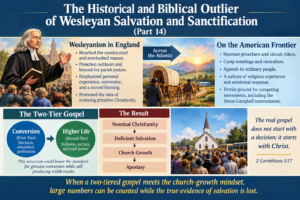 Among others, two major factors coincided to result in the spread of the Wesleyan distortion of the gospel. One, when a philosophy which measures ministry by visible growth, combined with a two-tiered doctrine of salvation, the movement could preserve the appearance of Christian success while lowering the standard for what it meant to be genuinely converted. Two, Wesley was a restorationist, promoting the notion that his Methodism would return the church to primitive Christianity. As a populist movement in England, it especially spread to uneducated masses not welcome in the parishes of the Church of England.
Wesleyanism then found its way to and caught fire on the American frontier, led by mainly experiential religion popular in these settings. Adherents, who sought a second blessing type of experience and were prey to foundational restorationist ideas, diverged from historical, biblical soteriology. The same American frontier environment that made experiential Methodism powerful also created fertile ground for several competing movements, including the Stone-Campbell restorationists. Those movements sometimes shared revivalistic methods and anti-creedal instincts while reaching dissimilar conclusions about conversion and baptism.
John Wesley’s movement in England became powerful. It reached people ignored by the established structures of English Christianity. He did not begin by creating a new denomination. He still operated within the Church of England. His work reached many working-class people, miners, laborers, and others neglected or rejected through the parish system. Wesley stayed outdoors when the establishment would not provide access. He carried his religious instruction to places where the state church had little influence.
Populism and Experience
This strategy gave Methodism a distinctly populist character. It did not require a person to possess the social position, education, or ecclesiastical connections. Religion became intensely personal and experiential. That feature of Wesleyanism became one of its greatest reasons for expansion. It also contained one of its greatest dangers. Christianity became closely linked to an individual’s religious experience. The experience itself then served as the main evidence of spiritual reality.
Wesley taught that the professing Christian should seek a subsequent work of grace, entire sanctification. Thus, the Christian life could be understood through identifiable spiritual experiences. A person with a first encounter of initial sanctification still needed something more. He could move from one recognizable spiritual condition into another.
Methodism on the American Frontier
American Methodism developed with extraordinary speed after the Revolution. The Library of Congress notes that Methodism, which began as a reform movement within the Church of England, had spread to the American colonies by the 1760s, and Francis Asbury became the great organizing force behind its expansion. Asbury traveled enormous distances on horseback, ordained thousands of ministers, and preached throughout remote portions of the young nation. This was exactly the kind of religious system that could thrive on the American frontier.
The frontier did not have established parishes, settled clergy, theological schools, or elaborate church buildings in the way older communities did. People moved west faster than traditional ecclesiastical structures could follow them. Methodism solved that problem through itinerant preachers, circuits, camp meetings, societies, and lay participation. As a result, the Methodist circuit rider became one of the defining religious figures of the American frontier. The preacher traveled from settlement to settlement rather than waiting for a settled congregation to build a permanent institutional structure. Methodism could therefore move with the population.
This occurrence was more than a logistical advantage. It shaped the character of American Christianity. Moreover, the frontier favored speaking accessible to ordinary people. It included meetings that drew large crowds, personal testimonies, emotional responses, public decisions, and religious experiences not requiring theological education.
Camp Meeting Religion
The camp meeting became one of the most important expressions of this frontier religion. Beginning in Kentucky around 1800, frontier Methodists produced intense camp meetings that brought large numbers of pioneers together for several days. The Library of Congress describes the Kentucky revivals as producing an especially emotional and demonstrative form of religious conviction. Methodists eventually adopted and institutionalized the camp meeting, making it one of their characteristic evangelistic practices.
This development is important for understanding the later history of American evangelicalism. In a camp meeting, a person did not merely hear doctrine. He came expecting something to happen. That expectation became part of American revival religion. The question increasingly became, “What happened to you?” A person could tell about the night he was saved, describe the place where he prayed, and tell how he felt. With Wesleyanism, there could be another testimony. The person received the second blessing and entered a deeper experience.
The frontier revival environment was especially compatible with Wesleyan theology. Wesleyanism supplied a theological explanation for successive religious experiences, while frontier revivalism supplied an environment in which those experiences could be publicly sought, testified about, and reproduced.
The Second Blessing on the Frontier
The Wesleyan doctrine of entire sanctification found a particularly receptive environment in nineteenth-century America. A frontier Christian could hear that the initial profession of salvation experience was both not enough and not the end. There was something more: a deeper work, a fuller blessing, and a higher experience of Christian living. That language changed among different groups, but the structure remained. This was not simply an intellectual doctrine. It became a religious pursuit.
People sought experiences. They attended meetings designed to produce experiences and listened to testimonies from people who claimed to have received experiences. They went forward publicly, prayed, and expected something to happen. This is one reason the Holiness movement could spread so effectively beyond formal Wesleyan denominations. The idea of a subsequent work of grace was portable. It could move from Methodist churches into revival meetings, camp meetings, independent ministries, and eventually other Protestant traditions. The second blessing became less a denominational doctrine and more a feature of American experiential Christianity.
The Frontier and the Rejection of Established Authority
At the same time, another feature of frontier Christianity deserves attention. The American frontier was suspicious of established authority. People had left established communities and moved into new territory. They did not necessarily possess strong attachment to inherited ecclesiastical institutions. They could hear a preacher outside the established structures and form a new congregation. This environment encouraged religious entrepreneurship.
A man with a Bible, a horse, a preaching gift, and a conviction could gather people. That meeting could spontaneously become a church. A “revival” could produce a movement, which also might turn into a denomination. Or a group could reject denominations altogether. The frontier therefore became a remarkable laboratory for religious experimentation. It very often made theological instability possible. People could reject one religious system without necessarily returning to the biblical foundations that had originally governed Christian doctrine.
Restorationism Enters the Same Environment
This is where the Stone-Campbell Restoration Movement becomes relevant. Barton W. Stone and Alexander Campbell emerged within the same broad American religious environment of revival, frontier expansion, denominational dissatisfaction, and appeals to the New Testament (NT). Stone organized the Cane Ridge revival near Lexington, Kentucky, in 1801. Stone and Campbell eventually became associated in the movement that produced the Disciples of Christ. The Cane Ridge revival is especially important because it demonstrates how closely revivalism, frontier religion, and restorationist impulses could interact.
Cane Ridge was not a Methodist event. Presbyterian ministers organized it. Yet it became one of the most famous examples of American frontier revivalism. Its intense emotional phenomena became notorious. Historical and biblical Baptists eventually repudiated aspects of the movement, while Methodists adopted and domesticated camp-meeting practices. Thus the same frontier culture could produce very different theological movements.
Wesleyanism said, in effect, that the Christian should seek a subsequent work of grace. The restorationists said, in effect, that Christianity needed to be restored according to the New Testament pattern. Both of these ideas operated within the same religious atmosphere. Restorationism arose partly from dissatisfaction with denominational Christianity. Its foundational claim was to return to the NT and recover the original church. Under these auspices, restoratiionists diverged sharply from historic biblical soteriology.
Wesleyanism and Restorationist Experientialism
Some restorationists came to emphasize baptism in a way that made water baptism function as the decisive point of remission of sins. The result was a significant departure from the historical, biblical understanding of justification by faith alone. Thus the frontier could produce two different kinds of departure from historical evangelical soteriology. One could make religious experience the decisive evidence of spiritual reality. The other could make a particular outward act the decisive point of receiving remission.
One could say: “I know I am saved because I experienced it.” The other could say: “I know I am saved because I was baptized according to the required pattern.” Neither approach keeps the biblical doctrine of salvation in its proper place. Christianity is experiential. A person must actually be born again, believe, love Christ, and walk with God. The problem arises when experience becomes the authority for defining what salvation is.
Wesleyanism could encourage a person to look within himself for a recognizable work of grace. Restorationism could encourage a person to look to a prescribed act as the decisive point. The biblical gospel directs the sinner to Christ and His Words. That distinction is crucial. The sinner does not rest ultimately upon the intensity of his experience. He does not rest upon the sincerity of his emotions, the date of his decision, or upon his baptism. He rests upon Christ and His Word. Genuine faith in Christ produces a new life.
The Frontier Made Religious Experience Reproducible
There is another important connection. Frontier revivalism did not merely make religious experience possible. It made it reproducible. Once a revival meeting produced conversions, other preachers could imitate the meeting. When a camp meeting produced dramatic responses, another camp meeting could reproduce the structure. As a second-blessing meeting produced testimonies, another meeting could seek the same result. The method could therefore become separated from the original theology. This became increasingly important as American evangelicalism developed.
The question was no longer simply: “What does the Bible teach about conversion?” It became: “How can we produce conversions?” And then: “How can we produce revival?” And then: “How can we produce the higher Christian life?” Eventually: “How can we grow the church?” The shift from biblical truth to reproducible religious experience was underway. The American frontier created something resembling a religious marketplace. There were Methodists, Baptists, Presbyterians, Disciples, Campbellites, Restorationists, Holiness groups, Adventists, Pentecostals, and many other movements.
A person could move from one meeting to another, and a preacher could leave one group and establish another. A new doctrine could be presented as a return to primitive Christianity, and a new experience could be presented as a recovery of apostolic power. The adherents could claim that older churches had lost something. This atmosphere made this religion highly mobile, which helped spread it. It also created an environment in which Christians could become accustomed to pursuing something new. That mindset eventually contributed to the endless multiplication of movements promising a recovery of something supposedly lost.
From the Second Blessing to Restorationist Expectations
Wesleyanism therefore contributed a particular expectation to American Christianity: Christianity can contain a higher experience than the ordinary Christian presently possesses. Restorationism contributed another expectation: the historic church has lost something and must be restored. When these ideas operate in the same environment, they can reinforce one another psychologically even when their doctrines differ. The Christian begins to look for what has been lost. A danger is that the Christian begins to live by religious dissatisfaction.
There must always be something more, always be something recovered, and always be another experience. This is one reason the nineteenth century became such fertile soil for religious movements.
The biblical gospel does not require the sinner to search for a missing spiritual experience. The sinner must repent and believe the gospel. A believer is justified. He is regenerated, receives the Spirit, becomes a new creature, is sanctified, grows, obeys, abides, overcomes, and is conformed to Christ. The NT does not tell the believer to find a second salvation. It does not tell him to locate the missing piece that will finally make him a complete Christian. It tells him to continue in the faith.
Paul writes, “As ye have therefore received Christ Jesus the Lord, so walk ye in him” (Colossians 2:6). The Christian life continues in the same Christ whom the believer received at conversion. It does not move from Christ to a higher experience.
The Frontier Legacy
The legacy of Wesleyanism on the American frontier therefore extends beyond the growth of Methodism. Wesleyanism helped establish a form of Christianity that was intensely personal, experiential, revivalistic, and accessible to ordinary people. Methodism’s itinerant system allowed it to penetrate remote regions of the expanding nation. Camp meetings and revival practices made conversion and subsequent religious experiences public and reproducible. The Holiness movement then carried the Wesleyan doctrine of a subsequent work of grace beyond Methodism into a wider American religious culture.
At the same time, the same frontier environment produced restorationist movements that rejected denominational traditions and sought to recover what they believed was primitive Christianity. Both these movements participated in an American religious culture that increasingly valued immediate religious experience, visible response, and the claim to recover something that ordinary Christianity had supposedly lost. That environment became enormously influential.
It prepared the soil for later Holiness, Keswick, Pentecostal, revivalist, fundamentalist, and evangelical developments. The Wesleyan second blessing could become the Higher Life. The Higher Life could become Spirit baptism. Spirit baptism could become a distinct experience of power. The restorationist impulse could become a search for apostolic Christianity. Revivalism could turn conversion into a public event. And eventually church-growth methodology could turn religious response into measurable results. The streams increasingly flowed through the same American religious landscape.
The Dangerous Result
The greatest danger was not that Americans became more religious. It was that religious experience could become detached from biblical soteriology. A person could have a dramatic experience without biblical repentance. He could have an emotional conversion without saving faith, a second blessing without understanding sanctification biblically, be baptized without regeneration, join a church without being born again, claim an apostolic experience without apostolic doctrine, and a restoration without actually restoring the biblical gospel.
Because these movements were often extraordinarily effective at gathering people, their numerical success could reinforce confidence in their theology. That is the great danger of experiential religion. Something that feels powerful can begin to seem true because it does. What produces a crowd can begin to seem biblical because it does. But Christianity does not receive its authority from experience. The experience must submit to scripture.
When the biblical doctrine of salvation is placed beside these developments, the central problem becomes clear. The NT does not offer a first Christianity followed by a better Christianity. It gives one Christ, one gospel, one new birth, one justification, one Spirit, and one Christian life. That life begins at conversion and continues in sanctification. The believer does not need to find a second salvation somewhere on the American frontier. He needs to believe the biblical gospel, possess Christ, walk in the Spirit, obey the Word, grow in grace, persevere in faith, and pursue holiness.
More to Come