Part One Part Two Part Three Part Four Part Five Part Six Part Seven Part Eight An Aside (Between Parts Eight and Nine) Part Nine Part Ten Part Eleven Part Twelve Part Thirteen Part Fourteen
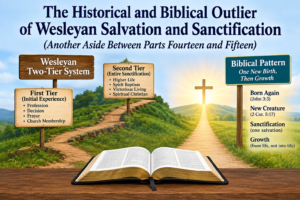 The Half-Way Covenant of the colonial Congregational Church offers a useful historical analogy. When the allowance of outward church standing continues without regeneration, the institution can retain unconverted people and religious practice can then become a substitute for genuine spiritual life. Dovetailing with this analogy, the concoction of a worship experience replaces true worship, actually serving as faux-evidence of a first-tier spiritual occurrence. The worshipers or the crowd determine the experience in conjunction with numerical results, which themselves become a self-fulfillment of a relationship with God.
The two systems, Half-Way Covenant and Wesleyanism, arose in different settings. The parallel is in the structural problem of preserving an outward religious constituency when regeneration is no longer the necessary foundation for that constituency. Historically, the Half-Way Covenant admitted a form of secondary membership to the next generation, the children and grandchildren of Puritans, without a demonstrated inward rebirth. Furthermore, Congregational practice later extended communion in the hope that participation might bring conversion to the admitted halfway church members.
The Two-Tier Gospel, Pragmatism, False Worship, and the Half-Way Covenant
Two major developments help explain how the Wesleyan distortion of salvation could become so influential. First, a two-tiered doctrine of salvation could combine with a pragmatic philosophy of ministry. If a movement measured success by visible growth, religious response, emotional experience, or institutional strength, the first tier of salvation could become increasingly superficial. A profession, decision, prayer, or intellectual assent could count as conversion even when no biblical evidence of regeneration existed.
Second, once that first tier became accepted as genuine Christianity, the movement needed a way to explain why so many of its members did not live like Christians. The answer was the second tier. Wesley provided one version. A person experienced an initial work of grace and then sought another work of grace, entire sanctification. Later movements changed the terminology. Some spoke of the Higher Life. Others spoke of Spirit baptism, victorious Christian living, fullness of the Spirit, or the spiritual Christian. Evangelicalism eventually spoke of the carnal Christian. The terminology changed, but the basic structure could remain.
There was the Christian who had received the first experience, and others had something more. That arrangement created a serious problem. If the first tier could consist of mere profession without the marks of regeneration, the second tier could explain the first tier’s spiritual weakness without questioning whether the person had actually been converted. The result was a mere form of Christianity that preserved the profession while lowering the standard for conversion.
When the First Tier Becomes Superficial
The New Testament (NT) does not present conversion as a superficial entrance into Christianity. Jesus said, “Except a man be born again, he cannot see the kingdom of God” (John 3:3). The new birth is not a religious classification. It is not a decision that merely places a person into a first category. It is a work of God that produces new life. Paul says (2 Corinthians 5:17):
Therefore if any man be in Christ, he is a new creature: old things are passed away; behold, all things are become new.
That is not a defective first tier. The man who is in Christ has become a new creature. He has not merely acquired a religious identity while waiting for a later experience to make him genuinely Christian. The biblical pattern is therefore different from the two-tier system. Growth follows the one new birth, sanctification proceeds from one salvation, and increasing conformity to Christ arises from one entrance into Christ. The believer grows because he possesses life. He does not grow into life.
This distinction matters most when ministry becomes pragmatic. If the ministry measures success by how many people come forward, pray a prayer, raise a hand, sign a card, join a church, or report an experience, whether those people actually possess eternal life becomes secondary. The first tier becomes easy to establish. The second tier then explains why the first tier does not look very Christian. That is a dangerous arrangement.
The Pragmatic Solution to a Theological Problem
Pragmatism asks a deceptively simple question: Does it work? But biblical Christianity asks another question: Is it true? The difference is enormous. If the first tier produces large numbers of professions, the method appears successful. When many people respond, the preacher appears successful. As the church grows in number, the ministry appears successful. If people describe powerful experiences, the meeting appears successful. The results can then become evidence for the method. That reverses the biblical order.
The church should not determine truth by observing results and then interpreting those results as God’s approval. The Word of God determines truth, and the results must be judged by the Word. The church does not gather primarily to create an experience, satisfy an audience, produce an emotional response, or achieve numerical success. It gathers before God. God is the object, the audience, the authority, and the standard. That principle applies directly to salvation.
A religious response, a crowd, a prayer, an experience, and even church membership do not prove regeneration. The biblical evidence of spiritual life comes from the spiritual life itself. Jesus said, “Wherefore by their fruits ye shall know them” (Matthew 7:20).
The Two-Tier System Can Preserve the First Tier
This is where the two-tier doctrine becomes especially powerful as a system. Suppose someone makes a profession of faith. His life does not change. He remains worldly, does not love holiness or obey Christ, has little appetite for scripture, and has little interest in the church except when convenient. He continues in the same sins without serious repentance. The two-tier system explains. He is a carnal Christian. In other words, he is saved but not surrendered, converted but not consecrated, has Christ as Saviour but not fully as Lord, has the first blessing but not the second, and has salvation but not victory. He is in the lower category rather than the higher category.
The two-tier system can preserve the original, actually non-saving, profession indefinitely. A very serious question — Was he ever converted? — does not have to be asked. The system therefore can lower the first tier while protecting it. That is the danger of the structure. Instead of allowing a persistently unconverted life to challenge the profession, the theology can classify the person as a lower kind of Christian. The result is a large constituency of people who think they are Christians because they possess a past religious experience, while their present lives provide little biblical evidence of conversion.
A social consequence follows the theological problem. The issue is not merely that some people remain unconverted. If unconverted people become the norm, they eventually begin determining what seems normal for Christians.
A Historical Parallel: The Half-Way Covenant
As mentioned in the introduction, something similar happened earlier in colonial New England Congregationalism. The early New England Congregationalists had a comparatively rigorous conception of church membership. A person seeking membership was expected to give evidence of an experience of salvation and publicly relate that experience. The church was understood as a covenant community of those who professed genuine spiritual life. The problem emerged with the second generation.
Children of church members had been baptized as children of the covenant. As they grew up, a majority could not give evidence of personal conversion. Infant sprinkling isn’t conversion. It’s not even in the Bible. They were therefore in an awkward position. They belonged to the religious community in an outward sense, but they could not demonstrate the inward experience that had originally characterized full church membership. The Half-Way Covenant developed as a solution. The arrangement allowed people who lacked a demonstrated experience of conversion to possess a limited form of church standing.
In some churches, the Congregationalist members could own the covenant and have their children baptized while remaining outside full communion. The church wanted to preserve the religious community. The problem was the lack of demonstrated conversion. The solution was to broaden religious standing without requiring the same evidence of regeneration. Wesleyanism arose later and followed a different theological path (even though Wesley himself accepted infant sprinkling), but the structural resemblance is striking. The problem in both cases concerns the relationship between outward religious standing and inward spiritual reality.
From Half-Way Membership to Religious Assurance
The Half-Way Covenant eventually produced further developments. By the early eighteenth century, some churches admitted baptized adults who were not living scandalously to the Lord’s Supper, hoping participation might contribute to their conversion. Solomon Stoddard became especially associated with this practice in Northampton and western Massachusetts. Now the religious institution could retain people who lacked clear evidence of regeneration while continuing to treat them as participants in its religious life. This created an important distinction between belonging to the religious community and possessing genuine spiritual life.
Proponents of the Half-Way Covenant did not make a simple declaration that unconverted people were fully regenerate Christians. Historical practices differed from church to church, and the arrangement itself was controversial. But it shows a recurring temptation in institutional Christendom: when genuine conversion becomes hard to identify, broaden the category of acceptable religious membership. The Wesleyan two-tier system follows a similar dangerous pattern. Rather than narrowing the definition of salvation to the biblical marks of regeneration, it preserves the profession and creates a higher category for those who demonstrate apparently greater spirituality.
Once this happens, the direction goes downward. The first generation establishes a high standard. A second cannot reproduce it, so since the institution wants to preserve its numbers, it lowers the standard. A lowered standard produces more nominal members who participate in religious activities. The religious activity creates an appearance of spiritual vitality, which the institution interprets as evidence of God’s blessing. The original distinction between regeneration and religious participation becomes increasingly difficult to maintain. That is how apostasy can develop without beginning with an explicit rejection of Christianity.
When the Unconverted Become the Norm
Apostasy begins before people say they no longer believe. Before that, people call themselves Christians while changing what Christianity is. When unconverted people become a large portion of a church or churches, they don’t just remain there unchanged. They also influence what the church considers normal. Culture follows the population. If the majority identified as Christians are not regenerate, their desires eventually become Christianized. The church begins to accept what the unconverted already love. This happens gradually.
A church permits something because it does not want to offend people. It retains it because people enjoy it. Then it defends it because changing it would cost something. Eventually it calls the practice Christian. Instead of scripture defining Christian culture, the existing culture is telling Christianity what it can accommodate. This can affect any area of a Christian life: immodesty, loss of gender distinction, and worldliness in dress, irreverence in worship music, foul or profane speech, disinterest in biblical doctrine, acceptance of mind-altering substances, egalitarian marriages, immoral entertainment, and popular psychology shaping thinking.
Clothing becomes more immodest. Men and women become less distinct in appearance. What once appeared shameful becomes ordinary. Rock, pop, rap, and other forms of popular entertainment become acceptable as Christian music. Foul words or profanity enter Christian conversation. Doctrinal commitment weakens because doctrine becomes divisive, negative, or unnecessary. Alcohol becomes acceptable as an apparent liberty issue. Partying becomes compatible with Christianity because Christians should supposedly enjoy life. Tattoos become merely personal expression. Multiple piercings become culturally neutral.
The church does not necessarily announce that it has adopted the world. It stops resisting it. The culture becomes normal. Then the church calls this new normal culture Christian.
The Disappearance of a Distinct Christian Culture
The New Testament expects Christianity to produce a distinct way of life. Paul says (Romans 12:2):
And be not conformed to this world: but be ye transformed by the renewing of your mind.
The command assumes a distinction between the believer and the world. Peter says (1 Peter 1:14):
As obedient children, not fashioning yourselves according to the former lusts in your ignorance.
The believer does not continue to allow his former culture to define him. Peter continues (1 Peter 1:15):
But as he which hath called you is holy, so be ye holy in all manner of conversation;
Christianity therefore produces a different manner of life. The Christian is not merely someone who has added Jesus to the existing culture. He has entered a new life, now belongs to Christ, and his desires, values, conduct, speech, relationships, priorities, and worship progressively come under the authority of God’s Word. That produces a recognizable Christian culture. Christians live under a different authority and therefore develop different judgments about modesty, sexuality, gender, entertainment, speech, recreation, marriage, money, work, worship, and holiness. When that distinction disappears, the church has become culturally indistinguishable from the world.
When the Experience Does Not Produce the Culture
This creates a serious question for the two-tier system. If a person supposedly receives a first Christian experience and then later receives additional experiences of sanctification, Spirit baptism, fullness, victory, or spiritual power, what should those experiences produce? They should bring holiness, obedience, love for God, separation from sin, and a growing conformity to Christ. If successive religious experiences occur while culture remains substantially indistinguishable from the world, one should question the experiences themselves.
An experience that does not produce biblical fruit cannot authenticate itself. A person can say that he has experienced God. A congregation can say that God moved. A movement can report thousands of decisions. A conference can produce intense emotional responses. A church can have repeated revival meetings. But if these experiences do not produce a distinct Christian life, they cannot simply authenticate themselves. The question must return to scripture.
What kind of life does the gospel produce?
What kind of people does regeneration make?
What kind of worship does God accept?
What kind of conduct does the Spirit produce?
What kind of fruit follows genuine faith?
The First Tier Can Become the Permission Structure
This is another danger of the two-tier system. The first tier, which isn’t scriptural anyway, also becomes a permission structure. A person says, “I am saved.” Therefore, the worldliness does not threaten his salvation. Then he says, “I need to become more spiritual.” Worldliness becomes instead evidence that he needs a second experience, not that he was never converted.
So, the person seeks the next experience. He has it, and now he feels different. The experience confirms the original profession, but the underlying cultural patterns remain. He may still love the same entertainment, dress and speak like the world, pursue the world’s pleasures, resist doctrine, and approach worship according to personal taste. The new experience has validated the old experience without producing a distinct Christian culture.
Now the system has become self-protecting. The first experience validates salvation. The second experience validates the first. The absence of Christian fruit is explained as immaturity. Continuing worldliness is liberty. Lack of doctrinal commitment is tolerance. Worldly worship is relevance. The cultural assimilation is explained as evangelism. All this can continue without ever examining whether genuine regeneration occurred in the beginning.
False Worship and False Professions
Among other ways, false worship stabilizes a false profession. It becomes a mechanism by which the unconverted confirm themselves in their Christianity. When music sounds like the world, the unconverted feel at home. If the worship is designed around the congregation’s preferences, the unconverted become part of the standard. The church can therefore create an environment where the lost do not need to become Christians to feel like Christians.
Musical choices for worship relate to what the audience wants, not what God accepts. They also create experiences with a claim to authenticate true spirituality. In fact, these manifestations of the flesh and sensuality are the fruit of a lack of conversion. As a first-tier constituency became increasingly nominal, the world’s surrounding culture could enter Christianity without requiring the people to examine their salvation. Then further experiences could be added.
The experiences did not produce a distinct Christian culture. They actually helped preserve the existing culture by assuring the participants that they were already Christians and merely needed another spiritual experience. The system could therefore become increasingly worldly while becoming increasingly religious. That is one of the most dangerous forms of apostasy.
Religious Christianity Without Christian Distinctiveness
Eventually, the question becomes almost impossible to avoid. If the people called Christians look, sound, think, dress, entertain themselves, speak, worship, and pursue pleasure substantially like the surrounding world, what has happened? The answer cannot simply be that they need another experience. It is a deeper problem. The first tier was never biblical conversion. It was a superficial profession, which required a second-tier religious experience, one not produced by regeneration.
Worship became a means of validating the profession rather than an offering acceptable to God. The two-tier system protected the entire arrangement by explaining away the absence of Christian fruit. This inculcated a mindset that survived by dissatisfaction, always needing something more. In a meeting, that restlessness translates directly into escalation. An experience wears off, so the next meeting needs more stimulus to deliver it again.
A subsequent experience needs a time, a place, and a method. Phoebe Palmer designed her mid-19th century meetings so that people could seek the blessing, hear testimonies from those who claimed it, and be coached on how to get it. Part 14 of this series showed the same pattern on the frontier. A person came to a camp meeting expecting something to happen, and the question afterward was, “What happened to you?”
Worship Used as a Means of Producing the Second Tier Experience
The church, as a gathering, stopped being first an assembly of God’s priesthood offering spiritual sacrifices to Him (1 Peter 2:5). Instead, it became a means of producing something in the attendee. Worship is vertical in direction and edification is horizontal in effect. The two-tier gathering inverted that. The purpose was the effect on the worshiper so that the offering to God became the vehicle for that effect.
Once people become the audience, people become the judge, and their response becomes the standard. Two-tier theology makes that shift almost automatic. If the meeting exists to bring people into a second experience, the meeting succeeds when they have it. Frontier revivalism made religious experience reproducible. If one meeting produced the result, another could copy its structure. The question moves from “Does God accept this?” to “Did it work?” That is pragmatism, and pragmatism does not distinguish God’s presence from the effect of a well-built meeting.
The Doctrine Supplies the Interpretation in Advance
The biblical order runs from revelation to truth to faith to rightly ordered affection to response. The counterfeit runs from stimulus to sensation to excitement to interpretation to “God must be in this.” Wesleyan two-tier doctrine supplies that last step before the experience ever occurs. It teaches that a second work is known by experience, which provides the grid for whatever he feels. A surge of emotion, tears, a sense of release, or an overwhelming atmosphere gets named as the blessing, the fullness, the baptism, or the power.
An experience of this kind confirms itself. The meeting is built to produce the result, and the result then confirms the theology that built the meeting. Palmer’s own method asked the seeker to claim the blessing by faith and then testify to it, a kind of self-fulfilling prophecy. This is the distorted mirror I wrote about at the end of the worship series. A man honestly says, “I experienced this.” Even if his experience were real, Wesleyan two-tier doctrine was the false interpretation of it.
The Names Changed, and the Demand Rose
The vocabulary of the second tier changed: entire sanctification, then the second blessing, then the Higher Life, then Spirit baptism and power. The structure stayed, but each new name asked more of the gathering. A second blessing could be a quiet crisis at an altar. A baptism of power invites a demonstration. Ecstasy intensifies the experience according to the same logic. If experience is the evidence, then more intense experience looks like better evidence.
The emotional phenomena at Cane Ridge became notorious. Historical, biblical Baptists repudiated aspects of the movement while Methodists adopted and domesticated the camp meeting. Its mindset lived by dissatisfaction, always needing something more. In a meeting, that restlessness translates directly into escalation. An experience wears off, so the next meeting needs more stimulus to deliver it again.
Where the Stimulus Comes From
Music and atmosphere can associate entertainment, sensuality, theatrical excitement, or emotional manipulation with God’s presence. The worshiper then reads the sensation as proof that God is there and blessing him. The question becomes what kind of God the experience makes him feel he is approaching, instead of what God has revealed about Himself.
The two-tier gospel supplies the demand: there must be a higher experience, and it must be known. The atmosphere supplies the stimulus. The meeting’s own structure supplies the interpretation. The result is ecstatic worship, which is a counterfeit in the proper sense of the word. It claims to be something real, but it has a different origin and authority.
The Remedy Is One Tier, Not Less Joy
The remedy is not emotionless worship. Paul and Silas sang praises in prison, and the Psalms are full of gladness. The question is what governs the gladness. Paul’s command to be filled with the Spirit comes with an immediate description of what the filling looks like (Ephesians 5:18-19):
And be not drunk with wine, wherein is excess; but be filled with the Spirit; Speaking to yourselves in psalms and hymns and spiritual songs, singing and making melody in your heart to the Lord.
It produces speaking, singing, and melody directed to the Lord, with the mind engaged. Paul also gives the church an order for its meetings: “Let all things be done decently and in order” (1 Corinthians 14:40), because “God is not the author of confusion, but of peace” (1 Corinthians 14:33).
Because the believer is already “complete in him” (Colossians 2:10), the assembly does not exist to deliver a missing piece. Instead, God’s people offer to God what He has appointed, under His Word, which Peter calls “a more sure word” than even the most overwhelming experience. That is why the worship service and the one-tier gospel belong together. A church that knows it already has all of Christ can worship Him instead of trying to get something from the meeting. A second tier, once adopted, needs a meeting to produce it, and the meeting needs a feeling to prove it. That is the road from a two-tier doctrine to the experience of false worship.
From Wesleyanism to the Next Stage
The historical development now becomes easier to see. Wesley introduced a two-stage conception of Christian experience. The Holiness movement spread the expectation of a subsequent work of grace. Keswick transformed the second blessing into the Higher Life. Pentecostalism developed a subsequent experience of Spirit baptism and power. Evangelicalism adapted the structure into spiritual and carnal Christians. Revivalism increasingly emphasized decisions, professions, public responses, and measurable results. Pragmatism supplied a method for judging success.
The resulting nominal constituency could increasingly accommodate the surrounding culture. And corrupted worship could provide the atmosphere in which religious experience validated the profession. The result was a Christianity capable of retaining large numbers of people while making regeneration increasingly difficult to distinguish from religious response. The problem did not remain in Wesleyan and Holiness circles. It moved into broader evangelicalism, revivalism, fundamentalism, including independent Baptists.
When the two-tier structure combined with revivalistic methods, soul-winning statistics, public decisions, rededications, emotional appeals, and pragmatic measures of success, another form of the same problem emerged. That will be the next stage of the history. This two-tier doctrine does not merely produce a weak Christian tier; over time, a weak or nominal first tier can reshape the definition of Christianity itself.
More to Come