Part One Part Two Part Three Part Four Part Five Part Six Part Seven Part Eight An Aside (Between Parts Eight and Nine) Part Nine Part Ten Part Eleven Part Twelve Part Thirteen Part Fourteen An Aside (Between Parts Fourteen and Fifteen)
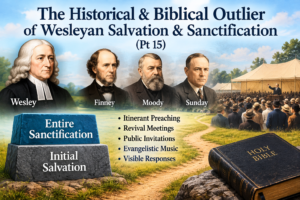 From Wesley to Finney to Sunday: The Rise of Modern Revivalism
John Wesley did not merely introduce a distinctive doctrine of sanctification. His ministry also helped establish a popular, itinerant, experiential form of evangelical religion that would shape later revivalism. Wesley did not invent itinerant preaching, mass evangelism, or revival meetings. George Whitefield and other evangelists also helped establish these practices. Nevertheless, Wesleyan Methodism became a significant force in spreading evangelical religion beyond established parish structures and into fields, villages, towns, and other places where people gathered to hear preaching.
This history matters because the movement toward modern revivalism involved more than a change in preaching methods. It also changed how many people understood conversion, how churches sought converts, and how they evaluated evangelism’s results. Over time, the public profession of faith could become more important than the biblical evidence of regeneration. People could judge an organized method by how many responded. This might be preferred to whether those people demonstrated the new life Scripture associates with salvation.
The trajectory from Wesley to Finney, Moody, Torrey, and Billy Sunday was not a simple chain in which each man received an identical doctrine from his predecessor. Their theologies differed, and each adapted the practices he inherited. Yet a historical connection exists through itinerant preaching, protracted meetings, public invitations, organized revival campaigns, evangelistic music, and the increasing expectation that a preacher should produce visible responses from an audience. These developments helped form the environment in which the two-tier conception of Christian life could survive and spread.
Wesley and the Itinerant Evangelist
John Wesley began his ministry within the Church of England. When parish pulpits closed to him, he preached outdoors and carried his message to people who would not attend church. His itinerant ministry, along with George Whitefield, helped establish the position of itinerant preacher, labeled an “evangelist,” as a recognizable religious figure. Rather than limiting his work to a settled congregation, the evangelist traveled from place to place, preached to large gatherings, and called people to respond to the message.
Wesley’s work helped popularize a religious culture in which preaching outside the established church, gathering crowds, seeking immediate responses, and emphasizing personal religious experience became prominent features of evangelical life. He also divided the Christian experience into an initial saving work and a subsequent work of entire sanctification. He did not teach the later evangelical doctrine of a permanently carnal Christian in precisely the form associated with Lewis Sperry Chafer. But the structure of an initial experience followed by a higher spiritual experience became a recurring feature of several later movements.
This pattern separated whether a person had experienced initial conversion from whether he possessed a subsequent spiritual experience. In later forms of evangelicalism, this distinction could explain the life of someone who professed salvation but remained worldly. The historical point is not whether Wesley personally intended every later development. Instead, it is how experiential religion, revival methods, and a two-stage conception of Christian life influenced the religious environment in which subsequent movements developed.
Finney and the Development of Revival Measures
Revival Culture
Charles Grandison Finney (1792–1875) stands at an important point in the development of American revivalism. Finney was not a disciple who sat under Wesley’s preaching. Wesley had died before Finney was born. Finney’s theological background also differed from Wesley’s. Yet the Methodist revival culture that had spread through America helped create an environment in which Finney’s approach could flourish.
Finney became especially influential through his evangelistic campaigns in the 1820s and 1830s. He developed and defended what became known as the “new measures.” These included protracted meetings, aggressive promotion, distinctive arrangements for seekers, the anxious seat, direct appeals for decisions, and methods designed to bring people to a point of public response.
Some of Finney’s methods had precedents among Methodists and other evangelists. Finney’s particular contribution was to organize and defend them as a systematic approach to promoting revival. His Lectures on Revivals of Religion explained his understanding of revival and the means he believed could produce it. Finney famously treated revival as the result of successful means rather than a miracle disconnected from human innovation. This was an important development.
Revivalist Methods
The “evangelist” was no longer merely a preacher who proclaimed biblical truth and trusted God to work through it. He increasingly became an organizer who could select, arrange, and employ methods to secure a desired response. Finney’s anxious seat illustrates the change. An evangelist could direct a person concerned about his spiritual condition to a designated place for special attention and prayer. The practice made the response visible. It gave the preacher and the audience a way to identify those who had responded to the message.
A public response is not necessarily wrong. Scripture contains public professions of faith, and the gospel demands a response. The problem arises when a particular response becomes a substitute for God’s work in regeneration, or when the method itself is treated as reliable evidence that regeneration has occurred. The New Testament (NT) does not establish the anxious seat, the modern altar call, or a standardized decision procedure as necessary instruments of conversion. The issue is not whether a person may come forward, kneel, pray, or publicly confess Christ. It is whether the method is allowed to carry an authority scripture never gives it.
Finney’s approach strengthened the connection between evangelistic methods and measurable results. If a technique produced more visible responses, its apparent success could be used to defend it. This created a powerful incentive for later “evangelists” to develop methods that could attract crowds and secure decisions. The issue was not that Finney alone introduced pragmatism into Christianity. Pragmatic tendencies existed before him. His significance lay in his unique and influential, extra-scriptural revival philosophy.
From Finney to Moody: Revivalism Becomes an Organized Campaign
Dwight L. Moody (1837–1899) helped transform revivalism into an organized form of urban mass evangelism. Moody did not simply reproduce Finney’s theology. He didn’t believe he could manufacture the work of the Holy Spirit. He emphasized the need for God’s work in the heart. Nevertheless, Moody adopted and adapted important features of the revival culture that preceded him.
Moody’s campaigns often involved cooperation among churches across denominational lines. Meetings were planned and advertised. Large audiences gathered to hear him. Ira D. Sankey’s singing played a prominent role. Those seeking spiritual counsel could be directed to inquiry rooms. The meetings became coordinated campaigns rather than ordinary church gatherings. Beyond speaking to crowds, he turned revivalism into a repeatable and organized enterprise. He recruited entire cities and interdenominational cooperation from their churches. His special music established the vibe of the meeting. Later reports could describe the apparent results.
Preaching to large numbers is not inherently unscriptural. Neither is church cooperation nor singing. The problem is transforming a particular method into a presumed means of producing spiritual results. A crowd is not a church, an emotional response is not necessarily repentance, and a recorded decision is not the same thing as regeneration. These campaigns reported hundreds of responses without demonstration that hundreds of people had been born again. Moody gave a framework for reproducing his same methods, even if future leaders modified the theological explanations that accompanied them.
R. A. Torrey and the Emphasis on Spiritual Power
Subsequent Distinctive Spiritual Endowment of Power
Reuben Archer Torrey’s (1856–1928) relationship with Moody was direct, unlike the one with Wesley and Finney. Torrey worked within the institutional and evangelistic world associated with Moody. He helped transmit that world to a wider audience. Torrey’s emphasis on the Spirit’s power for service took the trajectory of a continued search for a distinctive spiritual endowment beyond initial conversion. This wasn’t identical to Wesley’s doctrine of entire sanctification, nor to Pentecostalism. Nevertheless, the broader pattern is relevant.
Wesleyanism emphasized a subsequent work of grace; the Holiness movement, a second blessing; Keswick and Higher Life teachers, a higher or victorious Christian life; and Pentecostalism, Spirit baptism and power. Evangelicals who rejected some of these doctrines could still assume that a special experience beyond conversion supplied the power for a higher level of Christian living or service. The terminology changed, and the doctrines were not identical, but the recurring structure deserves attention.
Two Apparent Classes of Christians
With Torrey’s baptism of the Spirit, or fulness of the Spirit, he distinguished an initial Christian experience from a subsequent one expected to supply something essential to the Christian life. Scripture, however, does not teach two classes of Christians, one possessing ordinary salvation and another possessing an additional spiritual condition that makes the latter complete. The NT teaches believers to grow, be filled with the Spirit, walk in the Spirit, and pursue holiness. It does not teach that a believer must enter a second tier before becoming a genuine Christian in the fullest biblical sense.
Nothing in the Apostle Paul’s epistles establishes a permanent class of Christians who have received salvation but lack an additional initiation necessary to become fully Christian. Just the opposite. The danger appears when the language of power, victory, surrender, or spiritual fullness replaces an examination of whether the person has experienced the new birth and is growing in obedience to the Word of God.
From Moody’s Campaigns to Billy Sunday
The historical connection from Dwight L. Moody to Billy Sunday (1862-1935) is a direct lineage of mentorship and succession that shaped American revivalism. As Moody pioneered urban mass evangelism, he mentored Presbyterian pastor J. Wilbur Chapman and encouraged him to enter the same work. Chapman subsequently refined Moody’s large-scale campaign methods and, in 1893, hired former professional baseball player Billy Sunday as his advance organization assistant. Sunday spent nearly three years learning the logistical blueprint of mass revivals directly from Chapman.
Sunday’s meetings also show how far the mass evangelistic campaign had developed. The event could become a major civic occasion. Preparations, publicity, music, crowd management, and public responses all contributed to the campaign’s identity. His song leader, Homer Rodeheaver, helped give the campaigns their distinctive musical character. The music and speaking worked together to shape the atmosphere and move the audience toward a response. The musical portion of a gathering then became a tool for creating the emotional setting in which an invitation is delivered.
The public event and its techniques became the organizing principle of evangelism, so the gathering was judged by its ability to produce responses. Billy Sunday therefore belongs at the end of this historical line, because his work illustrates the further development of organized mass revivalism. By his time, the evangelistic campaign had become a familiar institution, complete with advertising, music, preaching, and public invitations. The next generations would inherit this structure and adapt it to new settings, including the revivalistic Independent Baptist and fundamentalist movements.
The Itinerant Mass Meeting and the Question of Biblical Authority
The Form of This “Evangelism”
The historical trajectory from Wesley to Finney, Moody, and Sunday raises a question about the form of this evangelism itself. The NT records public preaching, preaching in synagogues, proclamation in marketplaces, teaching in homes, and the gathering of crowds. It does not limit gospel preaching to a church building or a settled congregation. The question is not whether itinerant preaching or large gatherings are inherently wrong. It is whether a particular modern arrangement is the biblical pattern for evangelism and whether its methods should define conversion.
The modern revival campaign developed historically. Its particular combination of mass advertising, protracted meetings, a designated response area, coordinated music, and an organized invitation was not delivered to the churches as a single apostolic model. Finney’s “new measures” and later adaptations show how a method developed over time. A practice can be historically recent without being wrong. Scripture does not condemn something merely because it developed after the apostolic age. But it should not receive biblical authority simply because it is widely used, has become traditional, or appears to produce results.
The Purpose of a Church
The church must distinguish between the biblical command to preach the gospel and the methods people develop to carry it out. The gospel is not a method. Regeneration is not a decision tally. The church’s commission is not permission to treat any technique that attracts an audience as a divine ordinance. The danger is especially great when a campaign becomes the standard by which churches judge their own evangelism. A church easily begins to view ordinary preaching, teaching, discipleship, and church life as insufficient because they do not produce the visible results of a mass meeting. Evangelism can then become detached from the church’s ongoing work.
Yet the NT presents the church as more than a gathering for evangelistic response. 1 Timothy 3:15 calls it “the house of God, which is the church of the living God, the pillar and ground of the truth.” The church is to uphold the truth, teach believers, maintain biblical order, exercise discipline, and make disciples. Its life cannot be reduced to periodic public decisions.
The Invitation and the Profession of Faith
A Corrupt Religious Culture
The development of revivalism helps explain how a profession of faith became detached from the biblical doctrine of conversion. In the earlier stages of campaigns, a person might be identified as a seeker, an anxious person, or someone in need of spiritual counsel. Later revivalism increasingly emphasized the decision itself. Some evangelists used an anxious seat, others directed seekers to an inquiry room, and others asked people to come forward, raise a hand, repeat a prayer, or make a public commitment. All these contributed to a religious culture in which a visible act became the primary evidence that a person had received salvation.
Scripture commands confession of Christ and teaches the importance of believing the gospel. But a profession is not the same as the spiritual reality it professes. A person can say the right words without possessing the life of God. Jesus warned in Matthew 7:21, “Not every one that saith unto me, Lord, Lord, shall enter into the kingdom of heaven.” His words directly challenge the assumption that a religious declaration guarantees entrance into the kingdom.
The NT also presents the fruit of a changed life as evidence of genuine spiritual life. This does not mean that every true Christian displays immediate maturity or never struggles with sin. It means that conversion is not merely a past decision that becomes immune from examination. The new birth produces a new life (cf. 2 Corinthians 5:17). Christians must grow in that life, but growth is not an optional second tier that distinguishes genuine Christians from a permanently carnal class.
Decision-Centered System
A decision-centered system can give a person assurance based chiefly on a remembered event. If the person’s life remains persistently contrary to the profession, the system may tell him that he needs rededication, a second blessing, a victorious-life experience, or a fresh filling of the Spirit. Those experiences may become ways of preserving the original profession rather than deducing whether biblical conversion occurred.
Revivalism and the two-tier conception of Christian life can reinforce one another. The first tier supplies the profession and the second explains the absence of spiritual fruit. The method appears successful because the first decision “counts,” while explaining the person’s continued lost condition as merely a deficiency in Christian experience. That is not the biblical pattern. Scripture calls people to examine themselves, repent, believe the gospel, and walk in newness of life. It does not authorize pronouncing a person regenerate merely because he has completed a prescribed response.
Pragmatism and the Measurement of Success
Pressure to Measure Success
The growth of modern revivalism brought a corresponding temptation to judge evangelism by visible results. If a campaign attracted large crowds and produced many professions, people could describe it as successful. If a simple church did not produce comparable numbers, people could question its methods. The pressure to measure success could affect more than evangelistic technique. It could influence preaching, music, meeting length and structure, the presentation of the gospel, and the expectations placed on individual churches.
Pragmatism asks what works. Biblical faithfulness asks what God has commanded and what is true. Those questions are not always opposed: a faithful method may also be effective. But when apparent success becomes the final test of a method, Scripture no longer governs the practice. The method begins to govern Scripture interpretation.
As Applied to the Wesleyan Two-Tier Doctrine
This concern also applies to the two-tier doctrine of Christian life. If a preacher’s evangelistic system produces many professions but few lives that demonstrate genuine conversion, the system faces a serious question. Does the result indicate that the method needs reconsideration? Or does the system explain the discrepancy by classifying the converts as carnal Christians who need a higher experience? The second response can protect the method from scrutiny. It allows the evangelist to count the professions as successes while treating the absence of spiritual fruit as a problem for another stage of Christian life.
The result is a system that can preserve its own claims. The first tier supplies numbers. The second tier explains deficiencies. Another meeting provides another opportunity to respond. And the method remains in place because its measurable results are treated as proof of its legitimacy. But Scripture does not authorize this reasoning. The church is responsible to preach the gospel faithfully. It cannot guarantee regeneration by using the correct procedure. Nor can it turn the visible response to a method into proof that God has accomplished the new birth.
Revivalism and the Transformation of Church Worship
The Influence of Revivalism on the Church Gathering
This trajectory also connects directly with the question addressed in the series Is a Gathering of the Church, “a Worship Service,” a Biblical Belief? The NT describes the church as God’s house, a spiritual house, and a holy priesthood. 1 Peter 2:5 says that believers are “built up a spiritual house, an holy priesthood, to offer up spiritual sacrifices, acceptable to God by Jesus Christ.” The church’s assembly is not merely a public event organized to attract people and secure decisions. It is the gathering of a people who belong to God and who must approach Him according to His Word.
Revivalism altered the function of a church gathering. A revivalist campaign became the model — preaching, singing, and the invitation organized around the goal of securing a response. The gathering was judged by what the audience experienced and how many people responded. The issue is not that churches should never evangelize during their assemblies. The gospel should be proclaimed, and unbelievers may attend. The issue is whether the church’s gathering is governed by the biblical purposes of the assembly or by a model developed to produce a particular public reaction.
“Evangelistic Music”
The same question applies to music. Moody and Sankey helped popularize a form of “evangelistic music” closely integrated with revival meetings. Later evangelists adapted this approach to their own settings. Music could become a means of creating the proper atmosphere for the invitation. The audience’s emotional state could become an important consideration in designing the gathering.
Music is never theologically neutral. Its words communicate propositions, and its style can shape how people imagine the God they claim to worship. When musical choices are governed chiefly by their power to attract, excite, soothe, or move an audience, the audience’s response can become the practical authority over worship. The biblical question is not merely whether people enjoy the music or whether it helps them respond. The question is whether the church offers worship acceptable to God through Jesus Christ and in accordance with biblical truth.
When the audience becomes the practical measure of worship, the gathering begins to serve the audience. When the gathering serves the audience, the church can gradually accommodate people’s preferences. These are people whose desires the truth has not transformed. The music, language, dress, and expectations of the surrounding culture can then enter the church under the justification that they help the church reach people.
The church’s purpose is not to reproduce the surrounding culture with religious vocabulary. Romans 12:2 commands, “And be not conformed to this world: but be ye transformed by the renewing of your mind.” The church must not allow the methods used to attract people to determine the character of its worship.
From Revivalism to Nominal Christianity
System Prizing Visible Responses
Revivalism did multiply nominal Christianity. How? Mass evangelism does not necessarily produce false converts, and a person who responds at a public meeting may genuinely repent and believe. Neither itinerant preaching nor an evangelistic invitation is inherently corrupt. The danger arises when the method is treated as a reliable guarantee of conversion, when the church counts professions without sufficient concern for their spiritual reality, and when it is reluctant to question a profession that lacks the fruit Scripture identifies with salvation.
A system that prizes visible responses can create a large constituency of people who identify as Christians because they remember a decision, prayed a prayer, or responded at a meeting. Some may be genuine believers who need instruction and growth. Others may never have experienced the new birth. If the church does not take this distinction seriously, it may keep both groups under the same assurance without examining whether their professions correspond to biblical conversion. The two-tier conception of Christian life can worsen this problem by explaining the difference between profession and life.
The Process of Two-Tiers Produces Downward Trajectory
The professing Christian is told that he has the first experience but lacks the second. His worldliness becomes evidence of an incomplete Christian experience rather than a reason to examine the reality of his conversion. The church continues to count him as a success of its evangelism, even though the NT calls for evidence of new life. Over time, the people who lack a distinct Christian life can influence what the church regards as normal. Their preferences affect its music, standards, teaching, fellowship, and expectations. The church begins to accommodate the very world the gospel calls people to turn from.
This process can produce a downward trajectory. A church may retain its Christian name, continue its meetings, preach a message about salvation, and maintain a history of revival while gradually losing its biblical understanding of conversion and holiness. Its religious activities continue, but they no longer necessarily indicate spiritual life. The problem is not that true Christians never struggle with worldliness. They do. The problem is when a church redefines worldliness as a normal part of Christianity and uses past profession or religious experience to avoid meaningful examination.
The Historical Trajectory and Its Limits
The history from Wesley to Sunday does not mean that every later evangelist adopted every earlier doctrine. These men were not interchangeable, and the historical links among them varied. The argument is not that they all believed the same thing. Rather, they belong to a broader history in which itinerant evangelism, revival meetings, public invitations, specialized music, and visible responses became increasingly established features of evangelical religion.
The methods did not determine every later result, but they helped create a structure that later movements could inherit. Revivalism could be adapted to Wesleyan holiness, Higher Life teaching, Pentecostal experience, evangelical decisionism, and eventually revivalistic Independent Baptist fundamentalism. Each movement could retain the public methods while changing the theological explanation for what the response meant.
The Method Must Not Replace the Gospel
Revival Measures and the Gospel
The historical movement from Wesley to Billy Sunday reveals a significant development in evangelicalism. Itinerant preaching and variations on public evangelism grew. What evangelicals still called evangelism was often short or different from the biblical or historical evangel, that is, the true gospel. Revival measures became repeatable. Music, publicity, invitations, and visible responses became standard elements of many campaigns. Later itinerant preachers inherited and adapted this system.
None of this proves that every mass meeting is wrong or that every person who responds to an invitation is unconverted. The biblical issue is authority. The church must distinguish the command to preach the gospel from the methods developed to gather audiences and obtain responses. The gospel calls sinners to repent and believe. The new birth is God’s work. A profession must not be confused with regeneration, and a remembered decision must not become an unquestionable substitute for the evidence of new life. Neither a second blessing nor a later experience can replace the biblical responsibility to examine one’s profession in the light of Scripture.
Revival Measures and Worship
The same principle governs the church’s gathering. Its worship must not be organized chiefly around an audience’s tastes and responses. The church is God’s house, and its worship must be acceptable to Him. Its preaching, music, teaching, and practices must remain under Scripture’s authority. When the method becomes the measure of success, the response becomes the measure of conversion, and the audience becomes the measure of worship, the church begins to surrender biblical authority to human expectations.
Revivalism preserved the outward appearance of Christian activity while weakening the distinction between a profession of faith and the new birth. The two-tier conception of Christian life explains away the absence of spiritual fruit, while pragmatic methods continue to produce more professions. The church became increasingly successful at attracting religious responses while becoming less careful about whether those responses represent genuine conversion.
Part 16 will consider how this inherited revivalistic framework entered Independent Baptist and fundamentalist circles, where its methods and assumptions took on another form.